






06 November, 2026
Undermount vs Overmount Sink: How to Choose for Your Kitchen
Undermount vs overmount sink: our Australian guide explains the difference and helps you pick the right style for your benchtop and kitchen.

So, undermount or overmount? A quick guide to picking the right sink for your kitchen
Picking a sink in the kitchen aisle oughtn't feel like you're sitting a trade exam, yet somehow it does. The short version? Your benchtop decides this one, not your personal taste. No rim means no trapped crumbs, so undermount sinks look sleek and wipe down easily; top mount, on the other hand, is the simpler fit and a straightforward swap for an old sink. From what I've seen, most people skip the one step that actually matters: they fall for a style before they've even spoken to their benchtop maker or installer. Once that's sorted, everything else about this decision falls into place far more easily.
Video Credit: Ayhamceo
So what does 'undermount' and 'overmount' actually mean?
A sink can be fitted to a benchtop in two different ways, and the two terms above tend to cause a lot of unnecessary confusion.
In the first scenario, called overmount (or 'top mount' in Australian shops, including ours), a sink has a rim that sits on top of the benchtop. It is secured from beneath with clips. And the rim conceals the cut edge of the benchtop entirely.
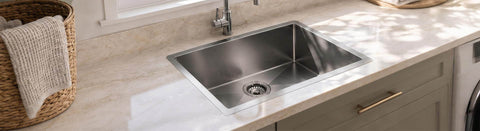
A second scenario is to fix the bowl of the sink below the surface of the benchtop, known as an undermount sink. There is no rim at the top of the sink, leaving the cut edge of the benchtop exposed. Because of this, the method tends to be fussy about which benchtop you choose.
Once you understand the two options of how a sink attaches, the next question is who determines whether a particular benchtop can be fitted with either type of sink cut-out.

What to Check With Your Benchtop Maker
Sinking a cut-out into a benchtop is not a choice that falls to you.
Only your benchtop maker or installer can advise if your benchtop is suitable for an undermount or flush mount cut-out. Materials vary, and so too do the edge profile and thickness. A sink hangs in a different way underneath a benchtop with no rim to hold it in place, and we will not tell you which benchtop material works best (that is your installer's decision to make).
Undermount, top mount and flush mount kitchen sinks all rule out engineered stone benchtops now, since every state and territory has banned the manufacture, supply, processing and installation of engineered stone benchtops, panels and slabs from 1 July 2024 (Safe Work Australia, engineered stone ban).
It's slabs the ban covers, not finished sinks — a granite or quartz composite sink is still fair game.
Worth remembering too: cutting the benchtop is a job for your benchtop installer, not a DIY task. Fitting the sink waste and tap afterward needs a licensed plumber, wherever you are in Australia.
Planning on a mixer? Check it carries WaterMark certification before handing it to your plumber for fitting (WaterMark Certification Scheme). Tapware must be WaterMark certified before a licensed plumber can install it.
You are ready to determine whether an undermount suits you and your life.

Undermount: Sleek lines and easy cleanup
Many people prefer an undermount sink because of its aesthetic appeal. With the sink mounted below the benchtop, there's no rim resting on top of the benchtop, meaning crumbs slide right into the basin. It does, however, leave the cut edge of the benchtop exposed, so make sure your benchtop supplier or installer is happy to cut an undermount sink before placing your order for one of our undermount kitchen sinks. It's also important to note that some undermount sinks are not compatible with top mounting, as some are listed as being strictly for undermounting, but others work with multiple types, so read the details, don't assume.

Top Mount: Easy to Install and Replace
A top mount (or drop-in) sink has a rim which sits above the benchtop and is secured with clips, hiding the cut edge of the benchtop. This makes top mount kitchen sinks a straightforward swap for an old top mount sink, since the new one might fit the existing hole if the cut-out sizes line up. Be sure to match the specifications of the new sink to the existing hole before ordering, and leave any cutting to your benchtop professional; don't do it yourself. The downside is the need for regular wiping of the edge where debris might build up over time.

Which Option is Right For You?
There's a third way to fit a sink: flush mount. With flush mount kitchen sinks, the rim of the sink is level with the benchtop, fitted into a rebate cut into the surface. There is no raised edge or overhang to clean. Make sure your benchtop supplier or installer can cut the rebate before committing to a flush mount sink. Confirm with your benchtop installer when the cut-out or rebate should be made relative to the sink's arrival. So, ultimately, choosing between an undermount vs overmount sink comes down to weighing the look you want, how much cleaning you're happy to do around the rim, how easy the sink will be to replace later, and whether your benchtop supplier will happily cut for a rimless look or match an existing hole. If you want the cut edge hidden and a wipe-clean join to the benchtop, undermount is the easier daily-clean option, but it costs more to fit and a swap later means re-cutting the stone. If upfront cost and simple, drop-in replacement matter more than a seamless look, overmount (top mount) is the straightforward choice, though the rim does collect crumbs and needs wiping around. In my view, it's one of those decisions that's best made before the benchtop is ordered, not after.
References
Engineered stone ban (model Work Health and Safety Regulations, in force in all jurisdictions from 1 July 2024), Safe Work Australia
WaterMark Certification Scheme, Australian Building Codes Board