11 June, 2026
Ambulant Meaning: a Plain-english Aussie Guide
Wondering about ambulant meaning in Australian bathrooms and building codes? Our plain-English guide explains it clearly.

Video Credit: Australian Building Codes Board
Whether you've just walked past signage in a bathroom in a mall, or you're in the process of doing a new commercial fit-out and are struggling to work out the building specifications, it's likely one word you may have noticed somewhere in your life, and you're now asking what does ambulant mean. It's kind of one of those words that seems like a term thrown around by those in the industry when discussing building and compliance when it is assumed that everyone else knows what it means.
What Does Ambulant Actually Mean?
Let's get it straight. Ambulant meaning, when we're talking about Australian building standards and bathroom designs specifically, refers to a person who can walk but may have limited mobility, balance difficulties, or rely on a walking aid such as a cane or crutches. The main reason why a standard bathroom would not work or be unsafe is because of their limited ability to walk or balance. They do NOT mean wheelchair accessible.
This will be a term thrown around when you come across Australian building codes or building product specifications. It might also be the term written on one of those bathroom signs on the outside of a public bathroom. You have seen that image where the sign doesn't look like the usual male or female sign, but neither does it look like a typical wheelchair sign. That is an ambulant sign that you have encountered, right in plain sight.

Ambulant vs Disabled: Understanding the Difference
Now that you have a good idea of what ambulant meaning is, it's also worth understanding the difference between that and 'disabled' — because in the building compliance industry, these two mean completely different things.
An ambulant facility is designed for someone who can stand and walk but needs support for doing it safely. A wheelchair-accessible or 'disabled accessible' facility, governed under AS 1428.2, has significantly different requirements — it will require substantially more floor space, a 1500mm turning circle for a wheelchair user, a floor-level shower recess, and door clearance dimensions that allow for chair entry. These are two completely separate legal classifications under Australian Standards — and critically, an ambulant facility is not a substitute for a full wheelchair-accessible one. Commercial and public buildings usually require both.
Just looking at the measurements will tell you all you need to know. The minimum dimensions of an ambulant toilet compartment must be 900mm wide by 1350mm deep. A full wheelchair-accessible disabled toilet needs much more space. Both are mandatory in many building classes — one cannot take the place of the other.

Australian Standards for Ambulant Facilities
It's one thing to know exactly who ambulant facilities are for. It's another thing entirely to know what specific legal requirements must be met, and that comes in the form of Australian Standards and the NCC.
Specifically, the key document here is AS 1428.1:2021, which covers dimensional and design requirements for ambulant accessible toilet compartments. The NCC 2025 refers to these standards and specifies that ambulant facilities are required in Class 5 to 9 buildings — office buildings, retail spaces, restaurants, hotels, and public buildings. Residential dwellings (Class 1) are usually exempt, although incorporating ambulant features in a home bathroom is definitely worth considering if you are renovating in preparation for ageing-in-place. The mandatory requirements under AS 1428.1:2021 include:
• A minimum compartment size of 900mm × 1350mm
• Grab rails on both sides of the toilet pan at 800–810mm from the finished floor level
• A door that either opens outward or slides — an inward-opening door is non-compliant, full stop
• A coat hook no higher than 1200mm above floor level

Ambulant Toilets: Key Features and Specs
Now that we have outlined the code requirements, let's go over what the actual ambulant toilet must have.
Seat height is the main specification to note. A standard toilet pan sits at around 400–430mm. However, an ambulant toilet must have a seat height of 460–480mm per AS 1428.1:2021 requirements. This is 30–50mm greater, providing a more comfortable lift for those with reduced leg mobility to stand.
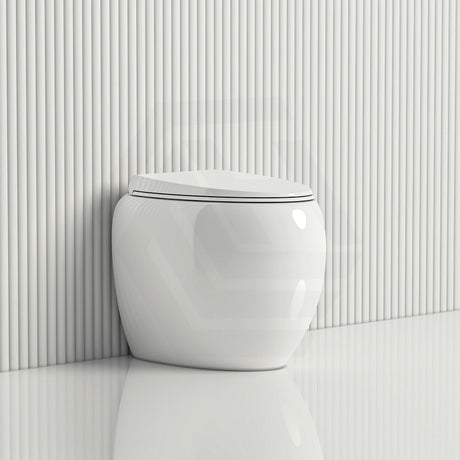
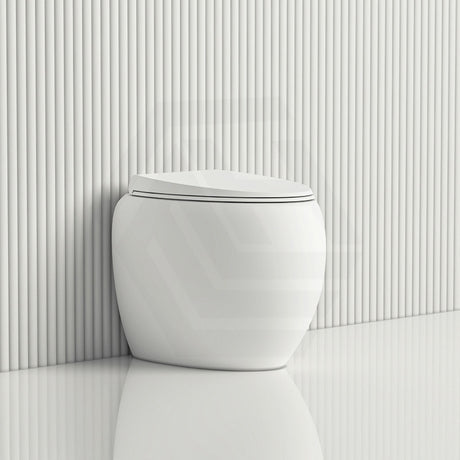
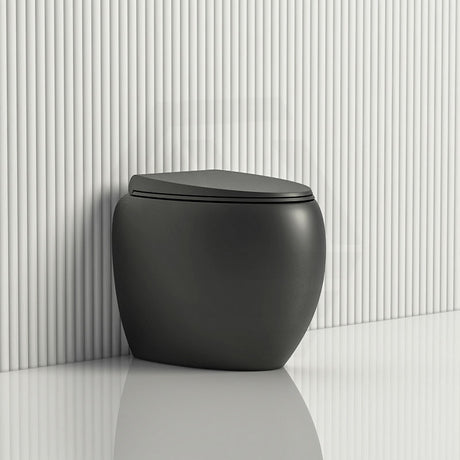
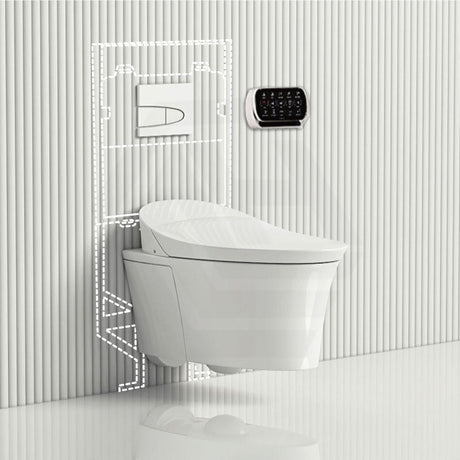
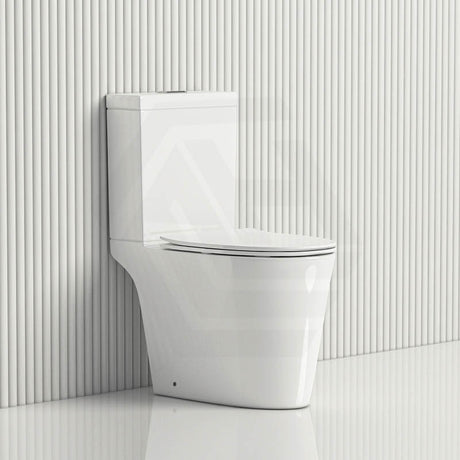
Back-to-wall or wall-faced toilet pans work well in an ambulant compartment as they are easier to clean, with no crevices in which dirt can gather or obstructions along the floor line — particularly beneficial in heavily trafficked commercial premises. Ensure you also purchase and install WaterMark-certified toilet suites, as non-certified fixtures are prohibited from sale and installation in Australia. Rimless pans are most commonly specified in a compliant commercial environment as they are easier to clean, more hygienic, and require less maintenance. Grab rails on each side of the toilet pan must be secured to solid backing in the wall by a licensed plumber or builder. An ambulant compartment floor must also meet a minimum P3 slip-resistance rating to AS 4586:2013.

Choosing an Ambulant Toilet
Right, that's the core of it — grab the suite that suits your space and what you're willing to spend. Every dimensional and certification requirement has to be met — that's just what ambulant compliance demands of your fixtures. Plenty of designs and styles exist — before you lock anything in, think hard about what your application actually needs and what your budget can handle.
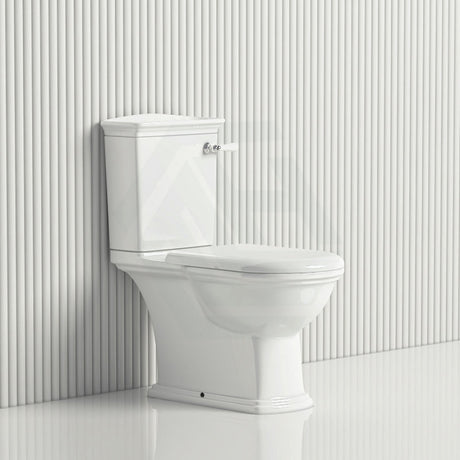
Back-to-wall suites suited to ambulant installs? You're looking at somewhere between $185 and $1,199 AUD. Poseidon and Fienza both stock compliant options — worth a look at each. WaterMark certification needs to be confirmed on every fixture, and the pan seat height must sit within the required range — sort both before you buy.
Here are the slip-ups that trip people up when selecting and fitting an ambulant toilet:
• A pan seat height that strays outside the 460–480mm range — a costly oversight
• No structural backing put in the wall before grab rails go up
• A door hung to swing inward when it should open outward or slide
One thing to be clear on: a disabled toilet belongs to its own compliance category entirely — it's no substitute for an ambulant toilet. Have a building certifier or accessibility consultant sign off on the design against AS 1428.1 before a single tool comes out. A clean, compliant ambulant bathroom fitout — budget on three to five days to see it through.
References
AS 1428.1:2021 Design for access and mobility, Part 1: General requirements for access — New building work, Standards Australia
National Construction Code 2025, ABCB Livable Housing Design Standard, Part 3 Internal doors and corridors and Part 4 Sanitary compartment
AS/NZS 6400:2016 Water efficient products — Rating and labelling (incorporating Amendment No. 1:2022 and Amendment No. 2:2022), Standards Australia
AS 4586:2013 Slip resistance classification of new pedestrian surface materials (incorporating Amendment No. 1:2017), Standards Australia