12 June, 2026
What is a Powder Room: a Plain-english Aussie Guide
Wondering what is a powder room? Our plain-English Aussie guide explains the difference between a powder room, half bath, and WC.

Video Credit: Architect Arslan.😎😎
So, What Exactly Is a Powder Room?
Put simply: a powder room is a small room that has just a toilet and a small hand basin. There is no shower, no bath.
I am going to say this clearly up front because this small space will be labelled all sorts of different ways: half bathroom, guest toilet, water closet (WC), powder room (yes, people still use this term), etc.
For the purpose of property valuations and real estate listings, Australian real estate agents will typically list half a bathroom as a half-bathroom. So you may see some properties with 2.5 bathrooms — the 0.5 being a separate, smaller room with the toilet and basin.
Back when it was in style for ladies to powder their face, these rooms were known as a "powder room". It was essentially a small room off the hallway or kitchen where ladies retreated to powder their face and touch up their appearance. Obviously, things have changed a lot since then, but the name "powder room" has stuck. In Australia, in the building and design world, the preferred term is powder room.
So, what is a powder room in practice? If you have a house that needs updating or you are building a new home, a powder room could be one of the smartest renovations you could do. A powder room located adjacent to the main living area takes a lot of load off the main bathroom, especially during the morning rush before work or school, or when guests are visiting. I have been working on renovation projects and building new homes for many years now, and I often recommend to clients that a powder room is one of the most cost-effective and practical ways of getting the most value out of a home renovation. Most powder room builds run three to five days on site when no structural changes are involved, with a full project timeline — including fixture ordering and permits — typically spanning four to eight weeks.

Powder Room vs Bathroom: Key Differences
It is important to get a good handle on this, particularly for those planning a renovation on a budget, or trying to interpret what a real estate listing says.
A standard bathroom usually has a toilet suite, a hand basin, and either a shower or bath. An ensuite adjoins the bedroom — usually the main bedroom — and can be a full bathroom or a partial one.
A powder room only has a toilet suite and hand basin. No shower, no shower screen, no wet area, no waterproofing membrane across the floor.
Because a powder room does not have a shower, many of the waterproofing and construction requirements for a standard bathroom do not apply. It is still important to check your state's specific requirements. Broadly speaking, a powder room can be constructed for considerably less than a full bathroom, with fixture and labour costs running from $3,500 to $8,000 depending on your finish selection and the complexity of the plumbing rough-in.

Standard Powder Room Dimensions and Layout
This is where so many renovation projects hit a brick wall. People underestimate how small a powder room can be — but also how cramped a poorly planned one will feel to use.
The National Construction Code 2025 Livable Housing Design Standard outlines the following minimum requirements:
• A clear opening width of not less than 820 mm (NCC 2025, ABCB Livable Housing Design Standard) for a doorway providing access to a sanitary compartment.
• A clear width of not less than 900 mm between finished surfaces on either side of the toilet pan.
• A minimum circulation space of 1,200 mm by 900 mm from the front edge of the toilet pan.
In practical terms, a workable powder room starts at around 900 mm by 1,200 mm — tight, but functional with the right fixtures. A comfortable layout is 1,200 mm by 1,500 mm or larger. Common mistakes include positioning the basin too close to the toilet (allow at least 450 mm centre-to-centre), under-specifying door swing clearance, and failing to confirm the toilet's setout — whether an S-trap floor outlet (typically 100–120 mm from the wall) or a P-trap wall outlet (185 mm setout). All of this must be confirmed before any wall framing is locked in.

What Goes in a Powder Room: Fixtures and Fittings
Once the floor area is locked in, fixtures are chosen according to priority. Essential items are a toilet suite, hand basin, basin mixer, mirror, towel ring, and toilet roll holder. Vanity cabinetry, an LED mirror, and a heated towel rail are worthwhile additions if budget and space allow.
In all states and territories, a licensed plumber must carry out all plumbing work — connecting and disconnecting fixtures to water supply and waste pipes is never a DIY job. On completion, the plumber must issue a certificate of compliance. All plumbing fixtures must carry WaterMark certification, and local plumbing authorities may refuse to certify work using non-certified fixtures.
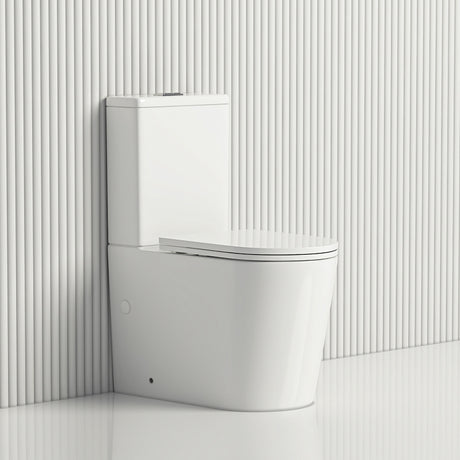
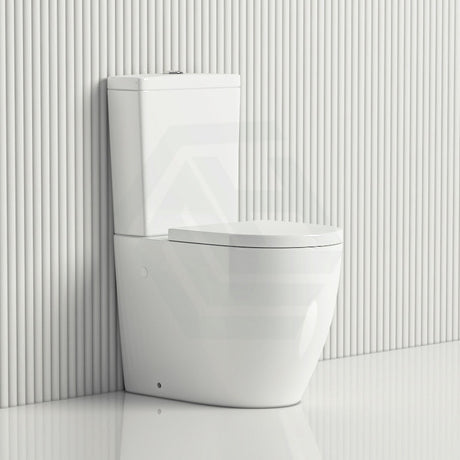
A back to wall toilet suite conceals the cistern inside or behind the wall, recovering 150–200 mm of floor depth compared with a close-coupled suite. Both Poseidon and Fienza offer back to wall toilet suite options ranging from $185 to $1,199. For a more contemporary finish with a larger budget, a wall-hung pan paired with an in-wall cistern is worth considering, with in-wall cistern options ranging from $165–$1,283.

Choosing Your Powder Room Vanity and Toilet Suite
A typical powder room vanity sits between 400–600 mm wide — well suited to compact spaces. Lukka and CETO both offer vanity options in these widths. Vanity cabinetry prices range from $50–$150 for budget options and $800 or more for premium cabinetry.
Vanity cabinets are typically manufactured from MDF, timber, or PVC. PVC is highly moisture-resistant, while timber and MDF suit powder rooms well but require some maintenance to stay looking their best.
Basin type influences tapware selection. A vessel basin requires a basin mixer with a longer spout than a standard recessed basin. A wall-hung basin attaches directly to the wall with nothing beneath it, which is ideal when floor space is limited.
The finish you select for your powder room vanity is where a powder room can really sing. One of the most common specifications I use is a black vanity with a matte finish — the presence this creates in a small space is striking, and it pairs particularly well with brushed brass or matte black tapware from Meir or Bella Vista. A matte finish also hides water marks, scratches, and fingerprints better than a polished finish, making maintenance considerably easier.
Proportions matter too. A 600 mm wide vanity in a 900 mm wide powder room can feel overwhelming and limits movement, whereas a 400 mm wide vanity leaves comfortable space and looks considered. Get the proportions right, choose a finish you love, and a powder room will not let your guests down.
References
National Construction Code 2025, ABCB Livable Housing Design Standard, Part 3 Internal doors and corridors and Part 4 Sanitary compartment
State and territory plumbing licensing authorities (Building and Plumbing Commission Victoria; Building Commission NSW / NSW Fair Trading; Queensland Building and Construction Commission; Plumbers Licensing Board Western Australia (administered by Building and Energy); Consumer, Building and Occupational Services Tasmania; Access Canberra ACT; Office of the Technical Regulator / Consumer and Business Services South Australia; Plumbers and Drainers Licensing Board Northern Territory)
WaterMark Certification Scheme, Australian Building Codes Board
AS/NZS 3500.2:2025 Plumbing and Drainage — Sanitary Plumbing and Drainage, Standards Australia