04 June, 2026
Toilet Room Ideas for Australian Bathrooms
Explore toilet room ideas that work for Australian homes. A separate toilet room can ease morning chaos and boost your property's appeal.

Video Credit: Tasha at Home
Why the Dedicated Toilet Room Works in Australian Homes
Picture this: It is early morning, and you have two adults trying to leave for work, plus kids trying to get off to school, and they are all fighting over one combined toilet and bathroom. The fix could be as simple as a toilet room, one of the easiest toilet room ideas you can implement when you are renovating.
Having a separate toilet room is one of the quickest, easiest and most effective ways to improve the quality of your home life, and it is becoming more and more sought after on the property market. It is especially relevant to Australian families, given that many of us live on standard blocks that range from 400–600 m² and have enough room for a separate toilet. They are also financially astute, with a toilet room adding value to the home for much less money than an extra bathroom. Many homes built in the last two decades already have rough-ins in situ, which makes the process easier. And you might be pleasantly surprised at how much easier it is to build a second toilet.

Space Planning and Dimensions for a Separate Toilet Room
You have decided that a toilet room is a good idea, and now you wonder where to put it in the floor plan. That all depends on minimum toilet room dimensions and smart space planning.
Before diving into any design details, make sure you are aware of all relevant National Construction Code 2022 (NCC) guidelines. NCC 2022 Housing Provisions requires that an accessible design toilet room will have a 900 mm × 1200 mm (NCC 2022, ABCB Housing Provisions, Part 12.2) clear space in front of the toilet and require an 820 mm door clear opening. A standard non-accessible toilet room will be 900 mm wide × 1200 mm deep, with the door opening outwards; if it swings inwards, it must be 900 mm × 1500 mm.
Sort out the door swing before anything else — it's one of the most common regrets homeowners end up with. A toilet room at 900 mm × 1200 mm leaves almost no room to move — an inward-opening door means you're wedged against the pan every single time. If the toilet room design has a hallway that prevents an outward-swinging door, a cavity slider door may be an option, as it does not take up any swing space.
Do not forget to think about ventilation early, because the space between the ceiling joists and within the wall cavity will determine where your exhaust fan ducting goes — do not make this decision after having rung up the electrician. You must have a minimum ceiling height of 2100 mm, but 2400 mm will feel much more comfortable, especially in a smaller space.

Fixtures, Finishes, and Materials That Suit Australian Conditions
With the footprint locked in, wall and flooring materials are the next decision to tackle. Basically, you want products tough enough to handle moisture, regular cleaning, and daily foot traffic.
For an Australian toilet room, porcelain floor tiles are hard to beat — denser than ceramic, far less absorbent, and much more resistant to household cleansers. Under AS 4586, any tile laid in a toilet room needs at least a P3 slip-resistance rating. Check the rating before you buy — plenty of tiles look the part but won't actually cut it. Porcelain floor tiles for a small room will generally set you back $35–$120 per m², so budget accordingly.
Large-format porcelain or ceramic in 600 mm × 1200 mm cuts down on grout lines — and that means less scrubbing over time. Outside the wet area, go with a moisture-resistant paint — one with a wet area rating and a mould inhibitor is essential in damp, poorly ventilated spaces. Grout colour has a surprisingly big impact on how bright and clean a small toilet room looks. Pair dark grout with light tiles and staining shows up fast. A mid-tone like warm grey or light stone holds up better over time and keeps the look tidy. Width of at least 1200 mm opens the door to a compact wall-hung basin — a 400–450 mm unit fits neatly beside the toilet for roughly $300–$800 in materials.

How to Pick the Right Toilet Suite for Your Toilet Room
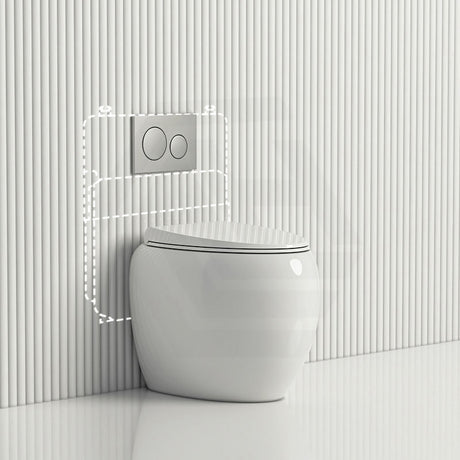
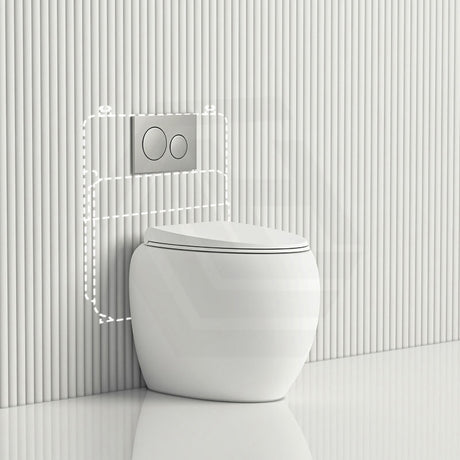
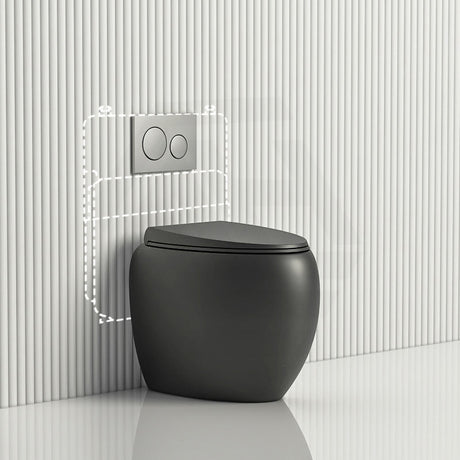
Once tiling is sorted, the toilet suite deserves attention — your choice here shapes how spacious the room feels and how easy it is to keep clean. With a back to wall toilet, the pan sits on the floor while the cistern hides behind it or inside cabinetry. Budget-wise it's an accessible choice — Poseidon and Fienza both stock suites in this style from $185–$1,199 AUD. Mount the pan to the wall with a floating toilet and you reclaim roughly 150–200 mm of floor depth, which makes the room read as noticeably bigger. Wall-hung pans from RAK Ceramics and Fienza start at $303–$934 AUD — bear in mind that price excludes the in wall commode frame. For a truly hidden setup, an in-wall commode tucks the cistern away inside a framed wall cavity. For this kind of setup, Geberit cistern frames are a widely used option. Any toilet sold in Australia must have WaterMark certification (WaterMark Certification Scheme) — a licensed plumber (state plumbing licensing legislation) won't touch an unmarked suite. Compliance aside, pan style has a real impact on day-to-day cleaning — rimless designs are far easier to wipe down than a ledge rim, which matters a lot in a small, high-traffic room.

Installation Tips and Pitfalls Worth Knowing About
A licensed plumber must do the install — DIY connections to the waste pipe and water supply are illegal across every Australian state and territory, and a compliance certificate is mandatory once the work is done. Skipping the rough-in measurement before tiles go down is an expensive error that's easy to avoid. Measured from the finished wall to the centre of the waste pipe, the S-trap setout usually lands at 100–120 mm. Skip that confirmation before tiling and the waste outlet might not line up with the pan at all.
With an in wall commode, the cistern frame has to go in before waterproofing or tiling starts, and the pan connection point needs proper waterproofing too — moisture trapped in the wall cavity can cause damage for months without a single visible sign, and fixing it up costs thousands. Most states require a licensed waterproofer to do the work, and under AS 3740 the membrane must run at least 150 mm up every wall.
Don't cut corners on the exhaust fan — poor moisture extraction is a fast track to mould in the grout lines and on painted walls. The wiring has to comply with AS/NZS 3000, and only a licensed electrician (AS/NZS 3000:2018) can make the connection to the power circuit — that's what brings the install up to code. Get your licensed plumber and licensed electrician on site together for the rough-in — it saves a lot of back-and-forth.
References
National Construction Code 2022, ABCB Housing Provisions, Part 12.2 Livable Housing
WaterMark Certification Scheme, Australian Building Codes Board
State plumbing licensing legislation (VBA Victoria; Fair Trading NSW; QBCC Queensland; Building Practitioners Board WA; CBOS Tasmania; ACTPLA ACT; Building & Energy SA; ABPB NT)
AS/NZS 3000:2018 Electrical Installations (Wiring Rules), Standards Australia