03 June, 2026
Small Powder Room Ideas for Australian Bathrooms
Explore small powder room ideas for Australian homes. Get expert layout and design tips for compact spaces that look stylish and work hard.

Video Credit: Decor Home Ideas
Why Powder Rooms Need a Different Design Approach
By their very nature, a powder room is going to be smaller than any other area in the home — it's the toilet and basin only, no shower or bath. Most Australian homes have powder rooms ranging from 1.0 m² and 2.5 m² in size, and it's the small size of these spaces that makes the planning and design process quite different. As a bathroom designer that has worked on new and renovation projects, I find that powder rooms are the areas where I'm most frequently consulted at the outset — because it's the powder room that homeowners tend to under-design the most, often requiring expensive rework if this is only noticed later on down the line.
Designing the layout of a powder room is the critical first step before you consider selecting any of the fixtures or fitting out the room. There is also no wiggle room with Australian building codes when it comes to the minimum clearances required (under the National Construction Code, NCC) to allow access to and for use of the toilet and basin — in this context, the standard minimum clear floor zones are: a 900 mm × 1200 mm (NCC 2022, ABCB Housing Provisions, Part 12.2) clear zone immediately in front of the pan; a basin centre at least 450 mm clear of any side wall; and a door with a minimum 820 mm clear opening. If your space is, for example, as narrow as 900 mm across, you will have very little margin for error — particularly if you are looking at using a standard size fixture.
The key to getting small powder room ideas right is in planning for the space that's available — the end result is what people actually enjoy — that experience of stepping through into a finished, thought-through and refined design.

Space-Saving Layouts and Sizing Specifications
Once you have determined the minimum clear floor zones required for the layout, the next step is choosing the right layout based on your particular floor plan size and the location of the door. I have found that for Australian homes, three configurations tend to cover most powder rooms — straight/galley, L-shaped and corner.
With the straight layout, the basin and toilet are on the same wall, you'll need a minimum wall run of 1600 mm to fit both in and are best suited to narrow rectangular floor plans, around 900 mm × 1800 mm. With L-shaped layouts, the basin is placed on the wall that's adjacent to the toilet, this often makes more efficient use of the available space and is typically better suited to near-square footprints (around 1200 mm × 1400 mm and up). The corner layout is the most space-efficient of the three, so I'll go into more detail later on what your options are.
Door opening direction can be a big factor to think about — a standard hinged door swinging inward into a 1.0 m² powder room will immediately compromise the clear floor zone. A pocket door or barn-style sliding door is the way to go — the additional $400–$800 installed is worth it to not compromise your minimum clear floor zones in a tight footprint. Ceiling height will also make more of a difference than you may think — with a powder room ceiling at 2700 mm, you'll have a more spacious feeling than the same floor plan with a 2400 mm standard height ceiling.
Before you buy anything, always check the rough-in. This is the distance from the finished wall to the centre of the floor waste outlet. For S-traps in Australian homes, this is typically 100–120 mm, whereas the P-trap sits at 185 mm back from the wall. Buying a suite and finding your toilet doesn't line up is a really common and really easily avoided mistake.

Materials, Fixtures and Fittings: What Works in a Small Powder Room
Next up, once you have your layout, is what to install. And, as you might expect from a small, busy space, material and fixture performance and maintenance are just as important as looks.
Large format tiles (specifically 600 × 600 mm) read well on the walls in a small powder room because there are fewer grout lines and therefore the space reads as bigger and cleaner. Mosaics look beautiful but introduce significantly more grout surface and require more diligent maintenance in a space with limited ventilation. In powder rooms where no showering is involved, waterproof paint can be an attractive, cost-effective solution, though most states still mandate waterproofing around the basin splash zone — confirm requirements with your licensed waterproofer before proceeding.
For basins, vitreous china is usually still the best choice. It's durable, non-porous, and starts at around $93 AUD for a wall-hung version. Stone resin is another strong option; Infinity have a range well suited to compact vanity configurations. A high-gloss basin might look great in photos but shows watermarks easily and needs daily wiping. A matte finish is more forgiving in real life.
All tapware and basins must comply with the mandatory WaterMark standard. All WaterMark Schedule products must also comply with the lead limit requirements from 1 May 2026 onwards.
Hardwired LED mirrors must be installed by a licensed electrician and comply with AS/NZS 3000:2018 (Wiring Rules) bathroom zoning. You can install a plug-in mirror yourself but do check there is a GPO near your vanity before deciding to do this.

Vanity and Toilet Selection for Tight Spaces
Now that we've dealt with the walls and floor, we need to deal with the vanity and the toilet suite. These are two separate fixtures serving separate functions, so check them both against the same plan to ensure that all clearances work.
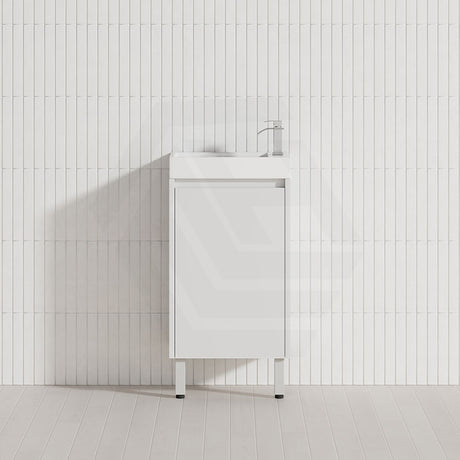
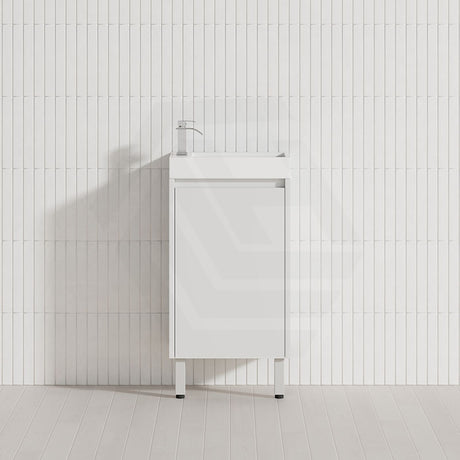
Vanity width is the main dimension to measure against your plan. A width of 400–600 mm is the recommended range for a powder room, and a small powder room vanity at this scale is a better fit than a full-width unit. A wall-hung vanity from Lukka, CETO or Aulic works well where your budget and style suit this approach — the floor remains visible and maintenance is much easier. A 400 mm wall-hung vanity with a semi-recessed basin will project only about 350–380 mm off the wall, leaving plenty of clearance in front of the toilet. Aulic's carcass is constructed from premium plywood and will outlast PVC, though the price reflects that. Be aware that most vanity cabinets are supplied without the basin mixer or waste — you will need to purchase these separately. A short basin mixer from Fienza or Meir will cost between $56 to $456 AUD.
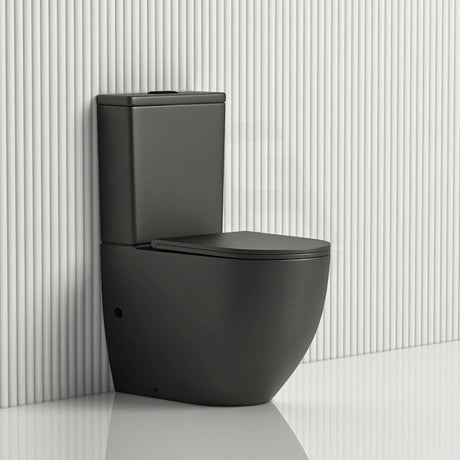
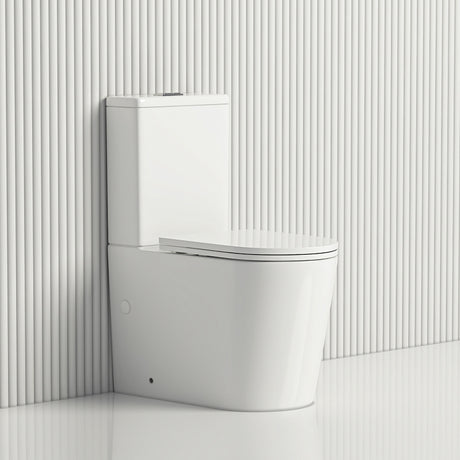
A back to wall toilet conceals the cistern within the wall cavity, removing the bulk of a conventional close-coupled suite. In a 900 mm wide powder room, that can free up an additional 150–200 mm of projection. Poseidon and Fienza both supply back to wall toilet suites ranging from $185–$1,199 AUD. A concealed cistern must be installed by a licensed plumber, so this needs to be included in your rough-in schedule whether you are building from scratch or renovating.
A corner vanity placed diagonally into a corner of a near-square layout frees up 200–300 mm of usable clearance along each adjacent wall — a meaningful gain in a tight footprint.

Lighting, Storage and Finishing Details That Maximise Function
Once your fixtures are set, lighting, storage, and ventilation are what will determine whether a powder room merely functions or actually works well.
Lighting is often overlooked. A single downlight centred over a vanity will cast shadows across your face. Vanity lighting should be positioned at eye height — a horizontal LED strip above the mirror or an LED shaving cabinet both work well. An LED shaving cabinet costs $390–$1,096 AUD and combines the mirror, lighting, and 100–150 mm of concealed storage in a single unit, making it an efficient solution for small powder room ideas in a compact space.
Once the lighting is sorted, ventilation is the next thing you cannot afford to overlook. The NCC mandates a minimum of 25 L/s (NCC 2022, ABCB Housing Provisions, Part 10.8) exhaust capacity in any windowless wet area. If your powder room has no window, an exhaust fan must be installed by a licensed electrician in compliance with NCC requirements. For powder rooms up to 2.5 m², an exhaust fan rated at 30–40 L/s with a 150 mm inline diameter is generally sufficient.
You can also recess a niche between wall studs to gain approximately 100 mm of depth and 300–400 mm of width for shelving without consuming any floor space. The final details matter just as much in a 1.5 m² project as in a large bathroom reno: confirm the installed projection of your vanity unit before purchasing, never order a toilet suite until you have confirmed the rough-in setout, and always schedule exhaust fan installation before the ceiling sheeting goes up.
References
National Construction Code 2022, ABCB Housing Provisions, Part 12.2 Livable Housing
WaterMark Certification Scheme, Australian Building Codes Board
AS/NZS 3000:2018 Electrical Installations (Wiring Rules), Standards Australia
National Construction Code 2022, ABCB Housing Provisions, Part 10.8 Condensation Management