09 June, 2026
Toilet Design Ideas for Australian Bathrooms
Discover toilet design ideas that suit Australian bathrooms. Practical advice on sizing, suite styles, and water ratings for any renovation.

Video Credit: Better & Best Products
Why Toilet Design Matters in Australian Bathrooms
Obviously, the toilet is the most frequently utilised component of any bathroom and is typically the final decision made when planning a bathroom renovation. I've designed countless bathrooms, spanning the budget end to the luxury end, across many layouts. In every instance, I've seen how this sequencing of decision-making results in difficulties. Because Australian bathrooms tend to be quite small and plumbing positions are fixed, if the suite selected happens to be the wrong dimensions, then you may find that you have to do expensive replumbing, or you may find that the suite won't fit.
Water use is another important consideration. All toilet suites sold in Australia are required to be WELS certified under the Water Efficient Labelling and Standards Act, and under the standard AS/NZS 6400:2016, which sets out the star rating and labelling standards for water-efficient products. A toilet suite with a 4-star WELS rating has a full flush volume of 4.5 litres and a half flush of 3 litres. The difference in water consumption per flush across the various star ratings will have a meaningful impact on water usage, and therefore the water bill, as well as the environment over the life of the toilet suite.
Given this, the most important considerations when picking toilet design ideas for a bathroom renovation are setout, space available and water consumption, with aesthetic options taking a secondary position.

Popular Toilet Styles and Their Practical Trade-Offs
In Australia, there are four toilet configurations available.
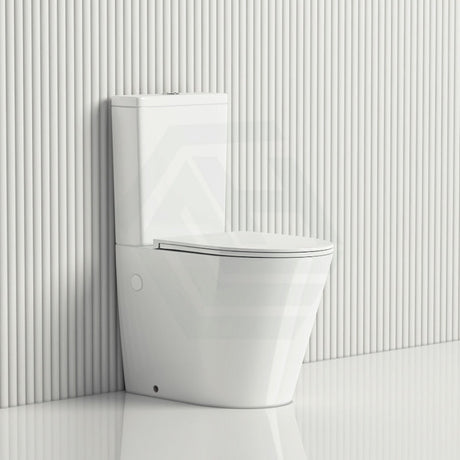
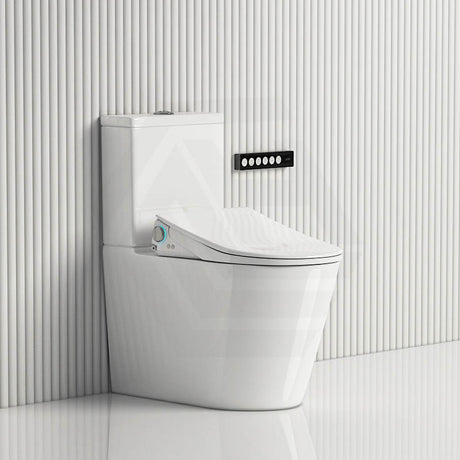
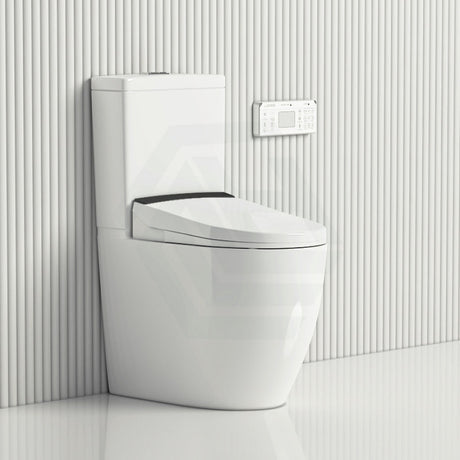
A close-coupled toilet suite, where the cistern is situated directly on the pan, is probably the most prevalent type in current homes and is by far the easiest to replace like-for-like. It also tends to be the most affordable, with some entry-level models priced below $400. However, the cistern is exposed and the suite projects further into the room than alternative configurations.
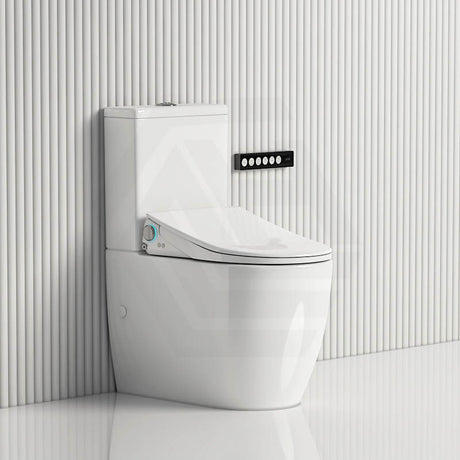
A back to wall toilet suite conceals the cistern inside a built-in or freestanding vanity cabinet, leaving only the pan exposed. It is, at the moment, the most common style of toilet suite in Australia — it reads as cleaner and more considered without the installation complexity of a wall-hung system. Retail pricing typically sits between $185 and $1,199 depending on brand and specification, making it accessible across most budgets.
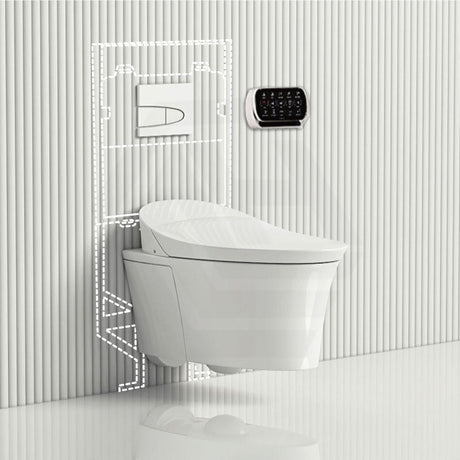
Wall-hung configurations take concealment further, mounting the pan off the floor entirely, with the cistern hidden inside the wall cavity. These have the most complex installation requirements and are generally seen in premium renovations, though they can create a sense of additional space in the bathroom.
Freestanding suites are visually striking but are a niche choice suited to larger bathrooms and premium renovations.
All products sold in Australia are required to carry WaterMark certification under AS/NZS 6400:2016 prior to supply, sale or installation.

Key Specs and Measurements to Know Before You Buy
There are three essential factors to consider when selecting a toilet suite.
Setout is the distance from the face of the finished wall to the centre of the waste pipe outlet. An S-trap floor outlet will measure 100–120 mm, and a P-trap wall outlet will measure 185 mm. Most residential properties in Australia use an S-trap setout; however, some apartments and renovated homes use a P-trap configuration. Ordering the wrong type means replumbing, not just returning a product.
Pan projection — the distance from the wall to the front of the pan — directly affects circulation space. Under the NCC 2025 Livable Housing Design Standard, a minimum clear circulation space of 1,200 mm by 900 mm must be provided from the front edge of the pan, with a minimum 900 mm clear width between opposing walls in a separate sanitary compartment.
Seat height — 400 mm is the most typical, but comfort height models sit at 450 mm. Comfort height seating is worth considering for any accessible bathroom design, and particularly for households where anyone has mobility requirements. These are crucial dimensions. I have seen too many bathroom projects where a suite was chosen on the basis of appearance alone, only to discover the setout was incompatible or the projection consumed the required clearance.

Wall-Hung and Back-to-Wall Toilets: Installation and Cost
The floating toilet remains a popular option for contemporary Australian bathrooms. The pan mounted at 400 mm off the floor gives the bathroom a more open, spacious feeling — a desirable trait in smaller bathrooms where large-format tiles can further enhance the sense of space.
However, a floating toilet is far from simple to install. It requires a concealed in-wall cistern carrier — the Geberit Sigma8 is an industry-standard reference for these systems — to be constructed within the wall cavity prior to tiling. In-wall cisterns range from $165 to $1,283, and wall-hung pans from $303–$934. The complete installed cost of a full floating toilet system, including a licensed plumber, wall framing, tiling and finishing, typically runs $2,000 to $3,500. All sanitary plumbing must comply with AS/NZS 3500.2:2025 (AS/NZS 3500.2:2025) and can only be carried out by a licensed plumber — check your state/territory requirements.
A back to wall toilet offers a very similar aesthetic for a considerably smaller outlay. Brands such as Poseidon and Fienza offer back to wall toilet suites in the $400–$800 range. The cistern is concealed behind a cabinet with an access door for serviceability. The back to wall toilet is generally easier and less expensive to service and repair than the floating toilet, though all plumbing work still requires a licensed plumber.

Rimless Toilet Designs and Hygiene
One of the most significant product innovations in Australian bathroom renovations over the past decade is the rimless commode. A standard toilet features a rim beneath the bowl from which water flows during flushing — an area notoriously difficult to clean and prone to bacterial build-up. The rimless commode eliminates that rim so that flush water cascades directly over the bowl surface, producing a far more hygienic result. Fienza's rimless range features Tornado flush technology and a Nano-Glaze coating, sitting in the $400–$800 price bracket. The Nano-Glaze reduces the porosity of the vitreous china, resisting staining and limescale. This type of feature is well worth considering for family bathroom toilet design ideas.
For any rimless commode, confirm it carries a minimum 4-star WELS rating and is plumbed to a dual-flush system — 4.5 litres for the full flush and 3 litres for the half flush. A soft-close seat with a quick-release hinge is a practical bonus, something most mid-range suites now include, making cleaning around the toilet considerably easier.
References
AS/NZS 6400:2016 Water efficient products — Rating and labelling (incorporating Amendment No. 1:2022 and Amendment No. 2:2022), Standards Australia
National Construction Code 2025, ABCB Livable Housing Design Standard, Part 3 Internal doors and corridors and Part 4 Sanitary compartment
WaterMark Certification Scheme, Australian Building Codes Board
AS/NZS 3500.2:2025 Plumbing and Drainage — Sanitary Plumbing and Drainage, Standards Australia