02 February, 2026
Why the Freestanding Oval Bathtub Is a Timeless Bathroom Favourite
Discover why freestanding oval bathtubs remain timeless: Elegant curves for comfort, versatile styles from classic to modern, durable acrylic/stone materials. Guide to sizes, placement tips & features like overflows for luxurious Australian bathroom upgrades.

The freestanding oval bath has become one of the most requested features I'm asked about, and I can see why. In 30 years working in design, I've seen bathroom fashions come and go — the avocado suites of the seventies, the spa baths of the nineties, those ill-advised walk-in showers that everyone thought they wanted — but an oval freestanding bath with a simple, elegant design? That never seems to get old.
So what makes the oval shape so appealing? It's organic, flowing, almost sculptural. Whereas a rectangular bath is defined by its hard angles, an oval oozes softness. It becomes less of a fixture and more of a sculptural piece that invites you to relax in it. And let's be honest: Who wouldn't want their bathroom to feel like a sanctuary, a place to escape the start of another day or the end of a crazy one, instead of just another functional room in someplace that you're trying to make cosy?

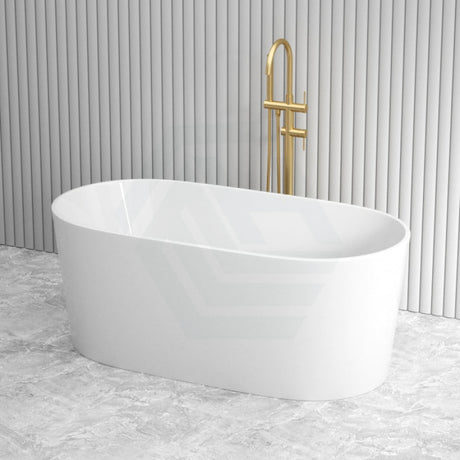
The oval shape offers broad appeal across different bathroom styles. I've specified oval baths for everything from tiny ensuites to hotel-style large bathrooms, and they are a design winner. I like how the edges are curved, great for a tight space as it is very easy to work around with no corners. In a larger bathroom, the oval bath becomes the hero piece — its curves act like sculpture and anchor what's happening around it.
A common concern is that freestanding baths take up more space than built-in options, but in my experience, this isn't always the case. And sometimes, in fact, they are the smarter option. I learnt this the hard way on our Umina Beach reno. The family bathroom had an awkward wall width that made fitting a standard built-in bath nearly impossible without doing some serious hacking about — and spending a tonne of cash and making a huge amount of mess. The solution? A carefully considered freestanding oval tub that gave us more design flexibility and looked infinitely more graceful than if we'd attempted to use a built-in.
The key is understanding your space and getting the proportions right. For curved baths especially, I like to allow 100–150mm at either end as a minimum — it gives the bath room to breathe. You want it to look like the bath was always meant to be there — not like an afterthought that got shoehorned in. Many oval baths taper inward, which allows you to see more floor around them. The more floor visible, the more spacious the room feels. It's a great example of one of those visual tricks that never doesn't work.

Material choice matters enormously too. When I'm designing baths for clients, I encourage everyone toward good materials that have stood the test of time. Composites have come a long way in recent years. There are now many products that replicate the look and feel of natural stone while being lighter, and as an ambassador for Planet Ark I'm heartened to see manufacturers bringing out more sustainable options. It's also worth considering not just aesthetic but the environmental impact of our material choices.

I recently installed a Moal oval freestanding bathtub for a client on the Central Coast, and she's delighted with it. It was not just the pretty curves or the good materials that sold them on it, but also how simple it is to clean around. One aspect that's often overlooked is maintenance. Freestanding bathtubs need to be cleaned all the way around them. I can't tell you how many times I see installs where the bath looks beautiful, but there's barely enough room to clean around it properly.
The placement of your tapware can significantly affect how your oval freestanding bath sits in the room. If you're positioning the bathtub away from a wall, floor-standing taps look great and provide more freedom — creating a beautiful island-esque feel. Wall-mounted taps are usually 9–12cm long, which means the bathtub needs to sit closer to the wall. They can look wonderful too — it depends on your room dimensions and plumbing layout. As always, be sure to speak with your builder and plumber before deciding on a setup, as not everything that looks this good is feasible for the size and space of your bathroom.

Oval baths remain popular because they work well across many design styles. If you're going for a New Century Modern look — my preferred approach that balances sleek lines with warm materials — an oval tub in matte white, or a stone-look finish, is ideal. Teamed with timber accents, and a little something like sage-hued tiles (which were featured in a calming kitchen we recently worked on), it's a space that feels current yet timeless. Or, if you're going for an old-school vibe, this oval bath would be equally stylish paired with traditional tapware and heritage-style tiles. It's their flexibility that makes them a smart buy.
At CERSAIE in Bologna, the fair I visit every September, I've seen oval baths featuring textured exteriors, ultra-thin edges, and more recently, colours beyond white. These updates give the oval a fresh and modern feel, which is what a years-long used bathroom fixture should do.

But the ultimate proof of any product for your bathroom is not in how it looks in a showroom but how it performs over time. Can you truly relax in it after a long day? Does it function well for how your family actually uses the bathroom? Will it look as beautiful in five years as it does the day you install it? With oval free standing bathtubs, the answer to all three is usually yes, which explains why they've become such favourites in bathrooms and why they hold up so well as a timeless choice.
If you're planning a bathroom renovation, visit a showroom and view the baths in person. Try to see how they feel, not just how they look in photographs. Touch the materials. View full-size displays, not just catalogues. Imagine it in your own bathroom, with your tiles, your lighting, and how you actually use the space each day. What works perfectly in one home may not be right for yours.
Your bathroom should be designed for you, for your family, for the way you live. And sometimes, the perfect answer is a beautiful oval bath that has graced our bathrooms for many years — and which may continue to do so for many more.