15 May, 2026
Wall Hung vs Freestanding Vanity: Which Is Right for You?
Wall hung vs freestanding vanity — our Australian guide covers installation, space and style so you can choose with confidence.

Video Credit: Bathrooms and More Store
This is the decision that trips up more renovators than anything else. I've stood in a bathroom showroom myself, mentally swapping between two very different visions for the same space. It's easy to do too. Once you start thinking about it, there are a lot of ideas to research. But once you know what each style actually requires, it doesn't take too long to work out which option is right for you.
What Is a Wall Hung Vanity?
A wall hung vanity, often referred to as a floating vanity, is a vanity cabinet that is attached directly to a wall and does not sit on the floor at all. It is held up by a fixing bracket or rail that is bolted to solid wall structure — either timber studs, a purpose-built noggin frame, or structural plywood sheeting. The height of the vanity from the floor can range between 450 mm and 550 mm, and the depth of the vanity can range between 350 mm to 500 mm, depending on the unit.
A wall hung vanity makes a real statement. Having a gap between the vanity and the floor instantly makes a room seem more spacious and airy, making it one of the best and easiest small bathroom ideas that don't involve major work to the space. It's also much easier to maintain and clean. This becomes a big deal if you've ever tried to mop underneath a full-sized heavy vanity that is mounted onto the floor.
Cabinets come in moisture-resistant MDF through to good quality plywood, with more premium ranges including a solid timber option. Aulic (an Australian-made brand, worth knowing if that matters to you) and CETO both use quality plywood construction with Häfele German hardware, offering soft-close doors and drawers as standard.

What Is a Freestanding Vanity?
So you know what a wall hung vanity is — it helps to compare this against the most common alternative before making your final decision.
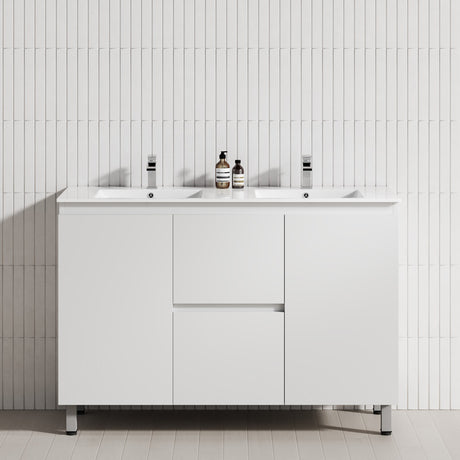
A freestanding bathroom vanity is a self-supporting cabinet that sits on the floor. Two main variants exist: the standard on-floor style, where a base cabinet sits directly onto the floor, and the leg-mounted style, where slim legs raise the cabinet off the ground while it still touches the floor. Standard sizing runs 850 mm to 900 mm in height including the benchtop, 450 mm to 600 mm in depth, and widths from 600 mm right through to 1500 mm.
I always prefer a freestanding bathroom vanity when designing for families because of the storage capacity it provides, particularly wider options with deep drawers. The leg-mounted design is one of my favourite bathroom vanity ideas for achieving a more contemporary look without all the structural work a wall hung vanity needs. PVC-carcass freestanding options are a smart budget choice too, as PVC is inherently waterproof in a way that standard MDF simply is not.

Installation Requirements and Structural Considerations
Once you've decided which type of vanity you'd prefer, you need to think about what each type of vanity installation actually demands. This is where the true complexity of the wall hung vs freestanding vanity decision becomes apparent. Your wall must be structurally sound enough to bear a dead load of 80 kg to 120 kg, meaning you may need to locate existing framing or create a dedicated backing frame using minimum 90 mm timber nogging or 6 mm structural plywood. If you plan to tile over plasterboard, that backing must be in place before waterproofing begins. The rough-in height for plumbing also needs to be set correctly before any tiles go on, because there is no flexibility afterwards to adjust it.
With freestanding units you're a lot more flexible structurally — a level floor and a standard plumbing rough-in are essentially all that is required. Common mistakes with wall hung installations include inadequate wall backing, incorrect rough-in height, and failing to account for tile thickness when positioning the fixing rail — all avoidable with proper planning.
With both vanity types, all plumbing connections — basin to water supply and waste — must be completed by a licensed plumber. Ensure all tapware and waste fittings are WaterMark certified before purchase, as non-certified fittings can fail plumbing inspections. If you are choosing a freestanding bathroom vanity, confirm the plumbing rough-in position suits the cabinet's waste outlet location before ordering.

Cost Comparison and Budget Breakdown
All that building and plumbing will incur costs, so bear these in mind when budgeting. A wall hung vanity cabinet costs around $400 to $2,500. A freestanding bathroom vanity cabinet costs between $300 and $2,000. The benchtop is purchased separately, starting from $150 for laminate or ceramic and $600 to $1,200 for stone or marble. Note that the vanity cabinet usually does not come with a basin mixer or waste fitted.
Vanity installation for a wall hung vanity involves two trades — a carpenter and a plumber — with combined labour costing $300 to $600. If the structural backing is not already in place, expect to pay an additional $200 to $500 for that preparation. A freestanding vanity requires just a plumber for the connections, at $150 to $350. Labour costs in Sydney or Melbourne will generally run higher than elsewhere in the country.

Which Vanity Is Right for Your Bathroom?
Once you've considered cabinet and installation prices, it comes down to what will work best in your bathroom. In a smaller bathroom — say, under 4 m² — a wall hung vanity makes more sense. The visual lift and clear floor space genuinely help make a compact room feel bigger, and it remains one of the most effective small bathroom ideas available.
In a family bathroom, storage tends to be the priority, so a freestanding vanity in 900 mm or 1200 mm width with deep drawers is usually the better fit. If you are renovating a rental property, a freestanding vanity is the safer, more flexible bet. If you are in a full reno with walls already open and budget available for wall preparation, a wall hung vanity becomes a very viable option.
As for the benchtop, that decision applies regardless of which cabinet style you choose — and this is an important distinction in the wall hung vs freestanding vanity debate. A marble vanity countertop adds a premium finish to either style. There are many marble vanity tops available in a range of sizes, colours, profiles and prices, so finding one that suits whichever cabinet you choose is straightforward. The benchtop is where you can add the finishing touch that makes the whole bathroom shine.
References
State plumbing licensing legislation (VBA Victoria; Fair Trading NSW; QBCC Queensland; Building Practitioners Board WA; CBOS Tasmania; ACTPLA ACT; Building & Energy SA; ABPB NT)
WaterMark Certification Scheme, Australian Building Codes Board
HIA (Housing Industry Association) — Bathroom Renovation Cost Guide 2025