02 October, 2026
Types of Cistern: Close Coupled, Concealed and Exposed
Explore the three types of cistern used in Australian bathrooms — close coupled, concealed and exposed — to choose the right fit for your renovation.

Choosing a toilet cistern shouldn't require a plumbing degree — yet here we are, drowning in jargon before we've even picked a tile. Australian bathrooms run on three types of cistern: close coupled, concealed (in-wall), and exposed. They each suit a different build context, budget, and look — and the differences matter more than most people realise before briefing their plumber. Close coupled suites start from as little as $248, while a complete concealed package can reach $1,657 — so getting across the options early saves a lot of costly backtracking (and a fair few headaches).
Video Credit: Everyday Home Repairs
Toilet Cisterns: The Basics of What's Inside and Why It Matters
Spend five minutes researching cistern types and the jargon hits fast — in-wall systems, WC, carrier frames — and what should be a straightforward buy starts feeling like a plumbing degree.
Three parts live inside every toilet cistern: an inlet valve to refill the tank post-flush, an outlet valve that releases water into the pan, and the flush mechanism itself.
Sell a cistern in Australia and it must clear the WELS water efficiency bar — that's the standard set under AS/NZS 6400:2016. To get average flush volume, one full flush plus four reduced flushes gets divided by five — the ceiling on that number is 5.5 L. Run the numbers on a dual-flush combo of 4.5 L full and 3 L reduced, and the average comes out at 3.3 L, which earns a 4-star WELS rating. Worth knowing before you lock anything in.
Australian bathrooms run on three types of cistern: close coupled, concealed (in-wall), and exposed. They each suit a different build context, budget, and look — get across the differences before you brief your plumber and you'll dodge a lot of costly backtracking.

Close Coupled Cisterns: How They're Built, Sized and Fitted
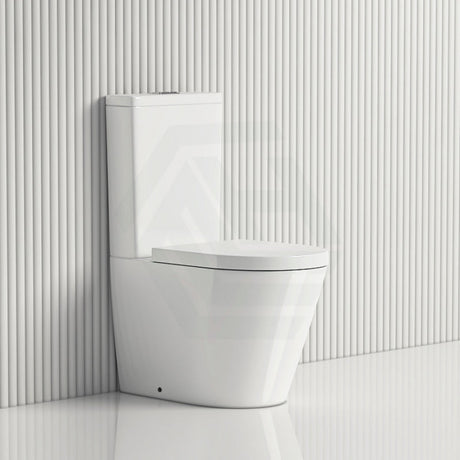
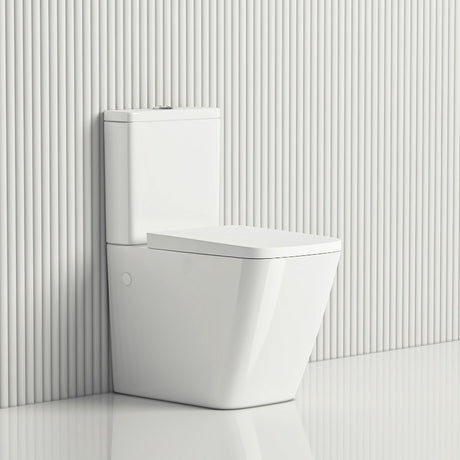
You'll find close coupled toilet suites in the majority of Australian homes — the cistern sits directly on top of the pan and the two are joined by a close-coupling kit.
There are many styles and shapes available, in both round and rectangular designs. If the pan is floor-mounted, it will connect to the outlet via an S-trap, or if wall-hung, via a P-trap.
The most common S-trap set-out in Australia is 180 mm from the finished wall to the centre of the floor outlet. There's no standard measurement for wall-hung toilets; they vary depending on the style.
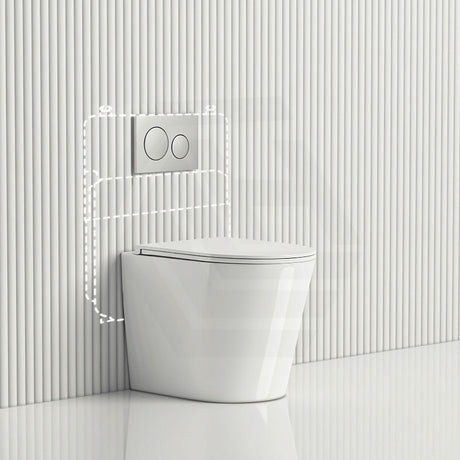
You can also find them in a combination of a back-to-wall pan and close coupled cistern for a more contemporary look.
Heights: - Cistern height: 350 mm and 400 mm (typical range) - Height of pan and cistern combined, from finished floor to the top of the lid: 780–800 mm
WaterMark certification is mandatory for any cistern sold in Australia, and water efficiency standards apply across the board. AS/NZS 6400:2016 governs WELS testing, and the WaterMark Certification Scheme for Plumbing Products is a separate requirement every cistern has to clear. How's average flush volume calculated? One full flush, four reduced flushes — add them together and divide by five. With a full flush of 4.5 L and a reduced flush of 3 L, the formula (4.5 + (4×3)) / 5 spits out 3.3 L — enough to land a 4-star WELS rating. The scheme caps the average at 5.5 L — go over that and you don't comply.
All plumbing connections must be carried out by a licensed plumber, and installation must comply with AS/NZS 3500.2:2025.
Close coupled toilet suites range in price from as little as $248 for a quality, entry-level option up to $1,060 or more for a mid-range option.

Concealed Cisterns: Inside In-Wall Systems and the Real Scope of the Work
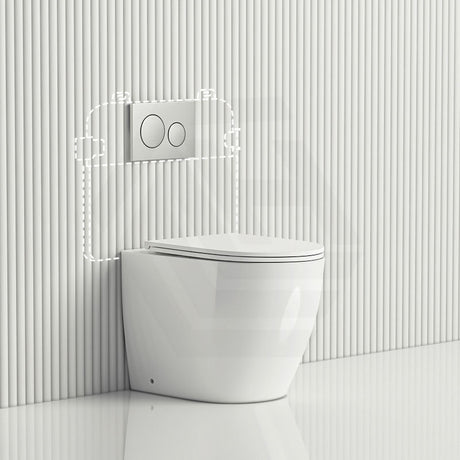
A concealed cistern tucks the tank away inside the wall — all you see on the finished surface is the flush button or plate. Depending on your preference, the pan can be wall-hung or floor-mounted.
Four parts make up the whole system: the cistern, a carrier frame to support it, the flush plate, and the pan.
The cavity has to be deep enough — at least 100–120 mm, or the cistern simply won't sit right. Steel or plastic — those are the two materials you'll see in carrier frames, bolted to floor and wall well before the lining stage. After tiling or lining is done, the pan clips onto the frame that's already in the wall.
A person's full weight goes through the carrier frame on a wall-hung toilet — get the fixing wrong during construction and there's no fixing it later without major work.
Talk to licensed plumbers around the country and Geberit is the name that keeps coming up for concealed in-wall cistern systems.
State and territory laws are clear: the pan and concealed cistern must meet AS/NZS 3500.2:2025, Plumbing and drainage – Sanitary plumbing and drainage, and every connection has to be made by a licensed plumber.
Price follows features closely — the in-wall cistern range runs from $165 at the entry end to $1,283 at the top. A complete dual-flush package — pan, button, cistern, carrier frame — will set you back somewhere between $630 and $1,657. An access panel isn't optional with concealed tanks — without one, a plumber has nowhere to go when something fails.
There's a range of flush plates and buttons available to suit various decors.

Exposed Cisterns: High-Level Tanks, Back-to-Wall Options and What Sets Them Apart
If you like your pipework on show, an exposed cistern might be the right solution. There are two types: high-level (above the toilet) or back-to-wall.
High-level: The cistern sits at least 1.8–2.0 m above finished floor level, connecting to the pan by a pipe. It adds character to heritage bathrooms and suits a period look.
Back-to-wall: The cistern sits low behind the pan and, unlike a concealed system, doesn't necessarily need to be built into a structural wall. It can be housed inside a vanity unit or cabinetry.
The pan and cistern must comply with AS/NZS 3500.2:2025 and must be connected by a licensed plumber.
Pricing on high-level options varies a fair bit — get in touch with suppliers for a proper quote. Budget-wise, back-to-wall cisterns sit in much the same territory as close coupled toilet suite options.
Your space, your style preference, and your budget — those three things settle the decision. Just factor in that concealed installs carry a real price premium, and do it early in the planning. Browse our full toilet cistern range — there's something in there for every build.
References
AS/NZS 6400:2016 Water efficient products — Rating and labelling (incorporating Amendment No. 1:2022 and Amendment No. 2:2022), Standards Australia
WaterMark Certification Scheme, Australian Building Codes Board
AS/NZS 3500.2:2025 Plumbing and Drainage — Sanitary Plumbing and Drainage, Standards Australia
State and territory plumbing licensing authorities (Building and Plumbing Commission Victoria; Building Commission NSW / NSW Fair Trading; Queensland Building and Construction Commission; Plumbers Licensing Board Western Australia (administered by Building and Energy); Consumer, Building and Occupational Services Tasmania; Access Canberra ACT; Office of the Technical Regulator / Consumer and Business Services South Australia; Plumbers and Drainers Licensing Board Northern Territory)