29 September, 2026
Toilet and Bidet Dimensions: An Australian Size Guide
Understand toilet and bidet dimensions before your renovation. Covers Australian standard sizes, pan length, and seat height.

I often speak with homeowners planning a renovation about common stumbling blocks, one being buying the wrong size toilet. Toilet and bidet dimensions can have significant impacts, particularly when space is limited in the bathroom.
This post looks to clear up these issues and help you to avoid some of the potential costly errors when it comes to buying a toilet.
Buying the wrong size toilet is one of the most avoidable — and costly — mistakes in a bathroom renovation. Getting the dimensions right matters enormously, both for compliance with Australian standards and for how the finished space actually looks and feels. Pan length typically runs 650–750 mm, seat height sits between 400 and 430 mm, and new suites can range from $185 to $5,950 depending on style and brand (and there were so many to tempt me!). This guide walks through every key measurement so you can shop with confidence.
Video Credit: Bathroom Remodeling Teacher
Why Toilet and Bidet Dimensions Matter in Australian Bathrooms
The dimensions of a toilet suite are very important, both from a compliance and aesthetic aspect.
Compliance-wise, you need to be aware of the following:
- the NCC 2025 Livable Housing Design Standard requires that there be a clear circulation space of 1,200 mm by 900 mm (NCC 2025, ABCB Livable Housing Design Standard) in front of the toilet pan. The diagram below shows how this is measured. - if there is a separate sanitary compartment for the toilet, the clear width between finished walls must be at least 900 mm - any door opening into a sanitary compartment needs a clear opening width of at least 820 mm - all plumbing fixtures must be certified by local plumbing regulators (see WaterMark Certified for Plumbing Products) - plumbing connections must be installed according to sanitary plumbing and drainage standards under AS/NZS 3500.2:2025 - toilets are WELS rated in Australia and need to have WELS registration. Average flush volume must be at or below the current limit of 5.5 L. A dual flush toilet, with a 4.5 L full flush and a 3 L half flush, would average out at 3.3 L, resulting in a 4-star rating, for example - if a smart toilet or bidet toilet seat is installed requiring electrical work, that work must be undertaken by a licensed electrician in accordance with AS/NZS 3000:2018 - wall-hung pans need to be fitted on a frame suitable to the load-bearing requirements, which must be checked by a licensed plumber
From an aesthetic point of view, you also need to consider how the toilet is going to look in your bathroom. Will it suit the theme or be too large? This is especially relevant for smaller bathrooms.
This is why it is important to understand the typical range of toilet and bidet dimensions and specifications that you can choose from.

Standard Toilet Dimensions in Australia
Before you order a new suite for your bathroom you need to accurately measure the existing set-out. You'll also need to take into consideration the size of the new pan, including any other items that may be close to the pan.
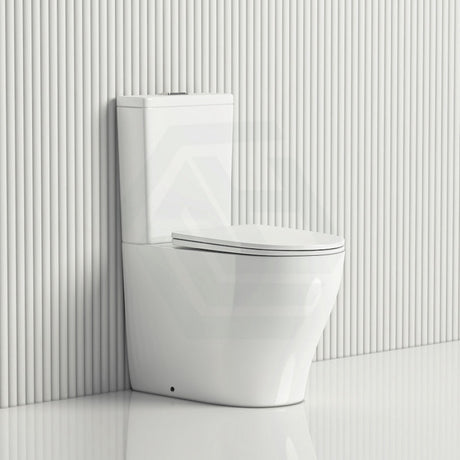
The following are the standard dimensions for an S-trap toilet, including the set-out.
Note, a steel tape measure should be used to measure these dimensions, and it should always be to the centre of the outlet.
### How to measure a set-out and other relevant toilet dimensions
Set-out is the distance from the finished wall to the centre of the floor outlet (S-trap toilets only). This is often 180 mm but can vary, including 160 mm or even 140 mm. There are also adjustable trap options which can be fitted across a range of 100–180 mm.
• Trap height – for a standard P-trap, this is the distance from the finished floor to the centre of the outlet into the wall. This height is commonly 185 mm.
• Toilet height – this is typically 750–800 mm tall, once the cistern is attached.
• Pan length – from the finished wall to the front of the pan, this is typically 650–750 mm.
• Pan width – this can range from 360–400 mm, depending on the pan.
• Seat height – for adult toilets, this is commonly around 400 and 430 mm from the finished floor level to the top of the pan rim. Junior toilets can be lower at around 385 mm.

Measuring Your Bathroom for the Right Fit
Understanding toilet and bidet dimensions in relation to your bathroom layout is essential before purchasing. When measuring, always use a steel tape measure to the centre of the outlet, and confirm whether your existing set-out falls within the adjustable trap range of 100–180 mm, which gives greater flexibility when replacing an older suite.

Choosing the Right Toilet or Bidet for Your Space
When it comes to buying a new suite, these can range from $185 to $5,950, depending on the style and brand, including options from Poseidon, Fienza, Kohler, Macho and Lukka.
If the space is limited then consider options such as:
• a wall-hung suite, as this will provide 150–200 mm of space saved on the floor. However, it will need to be installed onto a wall frame according to manufacturer requirements
• choose a smaller toilet pan size where possible
• consider the position of the door and how it will swing, ideally not entering into the toilet pan clearance area

Bidet and Bidet Toilet Seat Dimensions Explained
If you are looking to get a toilet and bidet installed in your home, there are a few options, ranging from a standalone bidet to a high-tech smart toilet.
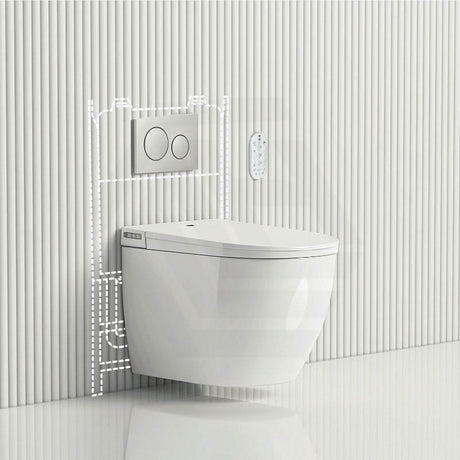
- Standalone bidets are installed next to the toilet pan as a separate fixture. These can typically be 350–400 mm wide and around 550–650 mm long, which can be a significant amount of extra space required in the bathroom. A recommended spacing of 200–300 mm between the standalone bidet and toilet pan side edges should also be factored in. - A bidet toilet seat is another option and is fitted directly to your existing toilet pan in place of the standard seat, so no extra floor space is required. These can cost between $219 to $1,846 depending on features. - Smart toilets are also available where the pan, cistern and bidet are all integrated and installed like a toilet suite. These units are typically a similar size to a regular toilet suite, but often are a bit longer in length, as shown in the diagram below.
The image below is a typical smart toilet, showing the toilet and bidet dimensions.
References
National Construction Code 2025, ABCB Livable Housing Design Standard, Part 3 Internal doors and corridors and Part 4 Sanitary compartment
AS/NZS 3500.2:2025 Plumbing and Drainage — Sanitary Plumbing and Drainage, Standards Australia
AS/NZS 6400:2016 Water efficient products — Rating and labelling (incorporating Amendment No. 1:2022 and Amendment No. 2:2022), Standards Australia
AS/NZS 3000:2018 Electrical Installations (Wiring Rules) (incorporating Amendment 3:2023), Standards Australia
WaterMark Certification Scheme, Australian Building Codes Board