16 June, 2026
How Many Liters in a Bath?
Wondering how many liters in a bath? Our Aussie guide helps you measure usage and save water on your household bills.

Who would have thought I'd be up at 9pm on a Tuesday night looking up how many liters in a bath? Me. A few months ago I noticed my water bill was getting quite high and I started to wonder if it was because I'd recently taken to enjoying two hot baths every week. The reality is, most of us don't even start thinking about how many liters in a bath until the point when it matters.
Video Credit: Topper Plays
Why Bath Volume Matters for Australian Households
With water prices rising significantly in Australia and water supply not being a certainty in parts of the country, such as Queensland, SA, or WA, understanding how many liters in a bath you are using at a time is important not only with regards to your household's water bill but also regarding how much your hot water system will need to service the water requirement of a nice, warm bath. With water restrictions being applicable in some areas, a nice long soak may no longer be on.
The typical water usage of a standard shower fitted with a water-efficient showerhead is around 9 litres per minute (these have been awarded a WELS rating, which is a rating system that helps to identify and regulate water-efficient appliances — AS/NZS 6400:2016). A six-minute shower will therefore use approximately 54 litres.

How Many Litres Does a Standard Bath Hold?
A typical Australian bath holds between 150 to 180 litres of water when filled to a comfortable bathing depth — usually 100 to 150mm below the overflow. A 1,500mm bath filled to the overflow will hold closer to 200 litres, while a larger 1,700mm bath can have a capacity of up to 300 litres.
It is worth noting that the quoted capacity of your bath is usually the total volume of the tub, which won't be the amount you actually fill it to. With the overflow preventing it being filled all the way up and your presence in it displacing water, the usable fill volume is always less. How many liters in a bath really depends on your bath size and how much you fill it.

Step-by-Step: How to Calculate Your Bath's Capacity
How many liters in a bath is an easy enough calculation if your bathtub is a standard rectangular shape. Take the internal length, internal width, and water depth, all in centimetres, and multiply all three together. Divide the result by 1,000 to get your figure in litres.
For example: a 1,500mm bath with an internal width of 700mm, filled to a water depth of 200mm — that is 150cm × 70cm × 20cm = 210,000cm³, divided by 1,000 = 210 litres.
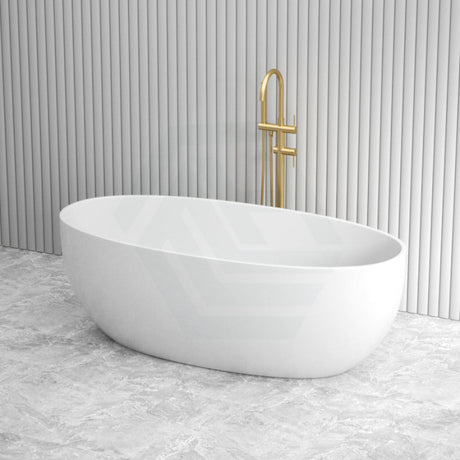
If your bath is not rectangular or is freestanding, the bucket method works well. Use a measured bucket — most standard buckets hold 9 to 10 litres — to fill the bath to its normal level and count how many you use. It takes a while, but it is accurate. Most freestanding baths have no overflow, so they are capable of being filled higher than a standard alcove bath. (You probably don't want to test that particular theory on a weeknight.)

Bath Sizes Available in Australia and Their Volumes
Once you understand the calculation, it helps to see how it plays out across common sizes. The most widely sold lengths in Australia are 1,500mm and 1,700mm, with 1,400mm and 1,800mm options available for compact or generous spaces respectively.
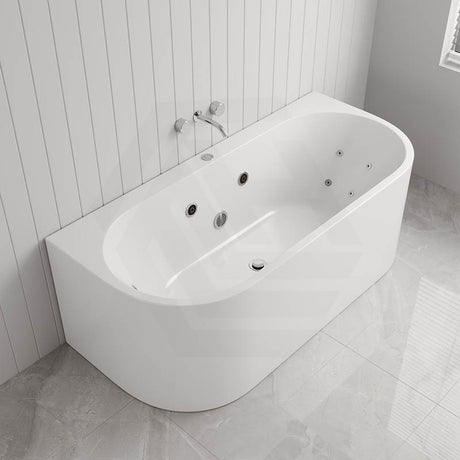
A 1,500mm bathtub typically holds 150 to 200 litres filled to overflow. A 1,700mm bath sits in the 200 to 300 litre range. Corner baths — which tuck neatly into a corner footprint — often hold 200 to 250 litres despite their angular shape. Freestanding soaker bathtubs tend to have deeper basins, so for any given length they will hold more water than a standard alcove bathtub.

Choosing the Right Bath for Your Space and Water Budget
You now know how to work out the water volume of each of these standard-sized bathtubs, but bear in mind that you need to consider your hot water system too. A 250-litre freestanding bath is a lovely idea until you realise your storage hot water system only holds 170 litres — meaning you will be topping up with cold water, which defeats the purpose. A continuous-flow system has its own limitations. Consider these things carefully before you fall in love with a display bath at the showroom.
Every bathtub must be WaterMark approved. WaterMark is Australia's mandatory national product certification scheme for plumbing and drainage products. Any plumbing connection to the water supply, overflow, or drain must be completed by a licensed plumber — it is an offence to carry out this work yourself.
On cost, drop-in baths start from $312, back-to-wall designs from $938, and freestanding options from $878. If you are fitting out a new bathroom, be sure to price a bath vanity and tapware as well. It is far more satisfying to get all the bathroom elements right from the outset rather than regretting a mismatched vanity later. Also note that water delivered to bathroom outlets must not exceed 50°C under Australian standards. When selecting your new bath, be mindful of the volume it requires and discuss this with your licensed plumber to ensure your hot water system can meet the demand.
References
AS/NZS 6400:2016 Water efficient products — Rating and labelling (incorporating Amendment No. 1:2022 and Amendment No. 2:2022), Standards Australia
WaterMark Certification Scheme, Australian Building Codes Board
State and territory plumbing licensing authorities (Building and Plumbing Commission Victoria; Building Commission NSW / NSW Fair Trading; Queensland Building and Construction Commission; Plumbers Licensing Board Western Australia (administered by Building and Energy); Consumer, Building and Occupational Services Tasmania; Access Canberra ACT; Office of the Technical Regulator / Consumer and Business Services South Australia; Plumbers and Drainers Licensing Board Northern Territory)
AS/NZS 3500.4:2025 Plumbing and Drainage — Heated Water Services, Standards Australia