19 May, 2026
Small Bathroom With Bath: How to Make It Work
Keeping a small bathroom with bath is worth it. Discover smart layout tips to maximise space, add value, and make your renovation work.

Video Credit: Contact Renovations and Custom Homes
Why It's Worth Keeping the Bath in a Small Bathroom
Almost without exception, I get asked "Should I lose the bath to make my bathroom bigger when renovating my small bathroom?" If your goal is value in the end product, it is worth keeping a bath in a small bathroom. It's a great selling point that will definitely increase the value of your home on the market. If you have children, it is highly likely they will require the benefit of a bath as they grow up, and real estate agents will tell you it will be harder to sell your small ensuite if you don't have a bath.
There is no denying that it takes up more space and uses more water, that is true. However, the truth is it doesn't have to take up as much space as you might imagine, and once you know how to make it work, a small bathroom with bath can look and feel spacious and welcoming. Let me explain.

Bathtub Sizes: What Actually Fits in a Small Bathroom
Now that you have decided to keep the bath in your small bathroom, you need to know how big a bath you can actually get away with. Often, the planning for a renovation will not go to scale with the measurements when it comes to fitting a bath, especially if the bathroom is tight. When you get mid renovation, the door won't open over your bath and the waste will go through the wrong wall.
Common or standard bathtubs in Australia are 1520 mm × 760 mm, which can work in a medium bathroom, but in a small bathroom is going to struggle. Smaller and compact bathtubs are 1200 mm and 1400 mm in length at around 700 mm wide, so you need to give those a strong consideration. A corner bath is 1200 mm × 1200 mm to 1350 mm × 1350 mm. Anything smaller than 1500 mm, in my professional opinion, will be very difficult to use and shouldn't be done. The measurements you need in a rough-in are from outside to outside — allow for wall framing and waterproofing membrane, which can add 30–50 mm per wall. Be sure to measure the swing of the door and the height of window sills.
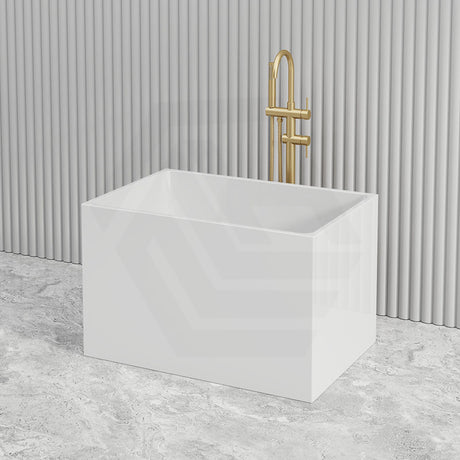
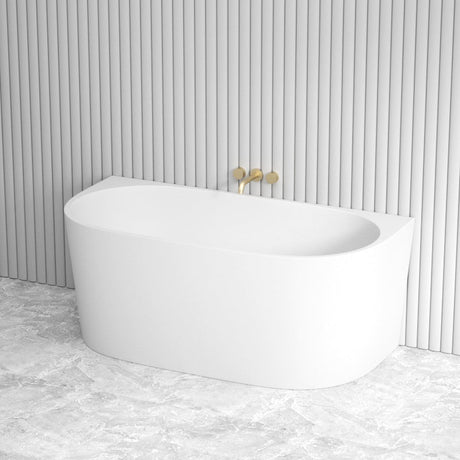
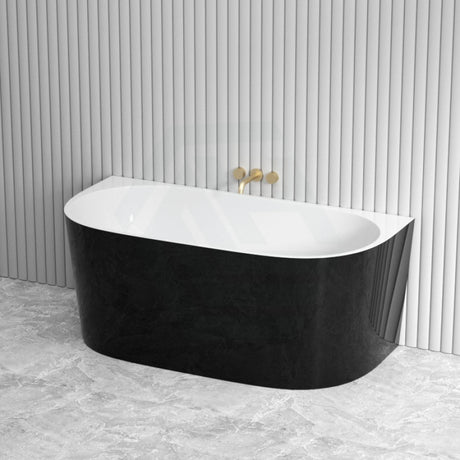
The NCC 2022 Livable Housing provisions also require an 820 mm (NCC 2022, ABCB Housing Provisions, Part 12.2) minimum clear door opening for new Class 1a dwellings — worth knowing if you're renovating with accessibility in mind. Drop-in bathtubs, where the bath is encased by a tiled or other surround, start from $312. Back-to-wall baths, where one flat side sits against the wall, run $938–$2,085 and look very sleek and neat. Both are far more space-conscious than freestanding styles, which genuinely need 1800 mm (NCC 2022, ABCB Housing Provisions, Part 10.2) or more of clear floor space and frankly don't belong in a small bathroom with bath constraints.
That said, knowing the footprint of your bath is just the starting point, as the bath surround, layout, and fitout can make a cramped room surprisingly spacious.

Small Bathroom Ideas to Maximise Space Around the Bath
The most powerful small bathroom ideas principle I've encountered is this: remove everything from the floor that you don't have to have there. Wall-hung vanities are great options such as options from Lukka starting well under $500 for narrow widths can provide instant visual and physical floor space. Wall-hung toilets also reclaim 150–200 mm of depth over floor-mounted pans, which in a small space can be a big deal.
Recessed niches in the bath surround wall replace freestanding shelves without stealing a centimetre of floor space, and they look a lot better too. Pocket or barn doors eliminate the swing clearance of a hinged door; in a bathroom under 4 square metres, that saved arc of floor space is not insignificant. I also recommend large-format (600 mm × 600 mm or larger) light-coloured tiles, they have fewer grout lines read as less visual noise, and light colours reflect rather than absorb light — but beyond the visual tricks, don't overlook the practical side of keeping an enclosed bathroom healthy. In windowless bathrooms, the NCC specifies a minimum mechanical exhaust ventilation rate of 25 L/s (NCC 2022, ABCB Housing Provisions, Part 10.8); for small bathroom ideas in an enclosed space, moisture management is key.
Of all the small bathroom ideas you can consider, one of the best space-saving moves involves placing your bath in the corner — so let's look at corner bath options in greater detail.

Corner Bathtubs: A Great Bath Option for Small Floor Plans
In my view, the corner bath is the best choice for a genuinely tight floor plan. Positioned in a corner, you consolidate two walls, leaving the remaining floor space free for movement and access.
The tiny corner bathtub format starts from 1200 mm × 1200 mm, which is a workable footprint for a compact room. Broadway dominates here with the broadest range of configurations, while Poseidon and ABS also offer corner bath options across symmetrical and offset designs. In a symmetrical corner bath, the waste and overflow sit in the centre of the diagonal wall. An offset corner small bathtub will have the waste and overflow to one side, which may make for a more straightforward rough-in depending on where your pipes are. Confirm the waste location with your licensed plumber before purchasing.
Acrylic is the dominant material, accounting for 88 of the 128 bathtubs available at MyHomeware — and for good reason. It's lightweight, warm to the touch, and significantly easier to manoeuvre into a tight space during installation. If installing on an upper level, weight is a factor your builder needs to be aware of. Small corner bath tubs in acrylic range from $958 to $2,085; ensure all fittings are WaterMark approved.
A corner bath already frees up floor space, but adding a shower above combines two fixtures in one footprint — freeing up even more.

Shower Over Bath Ideas: Combining Two Fixtures in One Footprint
This is exactly what I would choose for a small bathroom with bath every time — a shower over bath setup that combines both fixtures into one single footprint. It's practical, very common, and with the correct implementation it can be an intentional design statement.
For shower over bath ideas, your next consideration is a screen versus a curtain. A fixed frameless or semi-frameless shower screen with AS/NZS 2208 safety glass certification gives a cleaner finish and keeps you drier. Covey produce a wide range of screens and a shower screen can start from $130, though a frameless walk-in option can run into the thousands. A shower curtain is cheaper initially, but the rod adds to the cost and nothing collects moisture quite like one — nor does it ever look as good. For a smaller space, I would recommend stretching for a quality screen.
The finished ceiling height should sit a minimum of 2000 mm above the bath rim for comfortable showering. Shower walls must be waterproofed to a minimum of 1800 mm above the floor substrate, and walls adjacent to a bath must be waterproofed to a minimum of 150 mm above the bath rim, as required by NCC 2022 Housing Provisions. This work must be completed by a licensed waterproofer. A twin rail shower set — with a fixed overhead rose and a hand-held shower on a rail — works perfectly over a bath. Fienza makes excellent options, with twin rail shower sets ranging from $269 to $1,784 depending on specification. Wall-mounted tapware with a wall spout, rather than a deck-mounted tap on the bath rim, also keeps the rim clear and less cluttered in a small bathroom with bath.
If small corner bath tubs are coupled with an overhead shower, this is an ideal arrangement — and once done right, it can feel impossible to consider otherwise.
References
National Construction Code 2022, ABCB Housing Provisions, Part 12.2 Livable Housing
National Construction Code 2022, ABCB Housing Provisions, Part 10.8 Condensation Management
National Construction Code 2022, ABCB Housing Provisions, Part 10.2 Wet Areas
AS 3740:2021 Waterproofing of Domestic Wet Areas, Standards Australia