27 May, 2026
Small Bathroom and Shower Ideas for Australian Bathrooms
Discover small bathroom and shower ideas for Australian homes. Smart layouts, fixtures and design tips to make every square metre count.

Video Credit: Naway Zee
A bathroom should be a relaxing sanctuary. A space you want to use. And a space that doesn't just fit the minimum requirements for use. In apartments, and older, smaller Australian homes especially, the bathroom is usually allocated the least amount of floor plan space. That doesn't mean it has to feel cramped though. A well-designed bathroom of 3 m² will still feel comfortable.
Why Small Australian Bathrooms Need a Smarter Layout
This is the most common mistake in bathroom renovation projects. People see and like a great vanity or amazing shower head, and they go straight out buying fixtures before determining the layout of the room.
In the case of Australian apartments and post-war homes, bathrooms commonly range from 3 m² to 5 m². There are strict minimum dimensions mandated by the National Construction Code you must plan for in your layout. These include 600 mm minimum clearances in front of the toilet pan, and minimum 900 mm of floor space in the shower area. There is also the consideration of ensuring the door is not going to hit the wash basin when it opens. In an extremely tight space the door opening direction alone may result in the loss of 300–400 mm of useable space.
So before buying anything, draw the layout and identify the required clearance zones. If there is a window, ensure fixtures do not obscure it. This is by far the most common mistake in planning small bathroom and shower ideas for Australian homes.

Shower Design Choices That Save Space Without Sacrificing Function
Once the room dimensions and all clearances are accounted for, it's important to think of shower design options. The size and shape of your shower is the largest single fixture in the floor plan and will have the biggest impact on the perception of how roomy the bathroom is.
A 900 × 900 mm corner shower base is the workhorse of small bathroom and shower ideas in Australia. It saves space, allows for easy circulation, and is suitable in almost all small bathroom layouts. A 1000 × 800 mm rectangle alcove configuration may be more comfortable to use if this fits the plan of the room. Walk-in wet room designs — no screens or doors, just a floor slope to a linear waste — can feel much more spacious even in the smallest bathroom footprint, as they allow the eye to see the full length of the room floor in a single view.
Frameless screens in 10 mm tempered glass compliant with AS/NZS 2208 give a much more open feel than semi-frameless designs. Hinged doors should be avoided in bathrooms under 4 m², as they require significant clearance; instead, consider a sliding or pivot glass screen. Waterproofing must extend to at least 1800 mm above the floor substrate (NCC 2022, ABCB Housing Provisions, Part 10.2) on shower walls, as mandated by NCC 2022 with AS 3740:2021 as the compliance pathway. A licensed tradesperson must carry out the waterproofing — this is not a DIY task.
Large-format tiles such as 600 × 1200 mm porcelain will help create a more spacious feeling by reducing grout lines. Pair them with a matte finish on floors for the P-rating slip resistance required under AS 4586.

Fixtures and Fittings Sized for Compact Bathrooms
With the shower footprint locked in, it's time to focus on the toilet and basin. The toilet suite you choose can make a real difference to the floor plan of your small bathroom.
A standard floor-mounted toilet suite typically projects about 750 mm from the wall. A back to wall toilet with a concealed cistern brings that projection down to 620–680 mm — modest on paper, but genuinely felt in a tight layout. Wall-hung pans save even more depth but require a licensed plumber to install the in-wall cistern. Ensure all plumbing products carry WaterMark certification and check the product label before purchasing.
Semi-recessed basins sit partially over the vanity benchtop, allowing a shallower cabinet depth. Round basins are a practical space-saving option — keep their diameter to no more than 400 mm. Low-profile tapware mixers with low projection work well for under-counter basins — and once the vanity layout is sorted, it's also worth thinking about ventilation. NCC 2022 requires windowless bathrooms to have an exhaust fan with at least 25 L/s exhaust capacity (NCC 2022, ABCB Housing Provisions, Part 10.8). LED mirrors and any other electrical products must be installed by a licensed electrician per AS/NZS 3000:2018.

Small Bathroom Vanity and Storage Options
A small bathroom vanity is both a practical storage unit and an aesthetic centrepiece, so it's worth taking time to find the right width, configuration, and material.
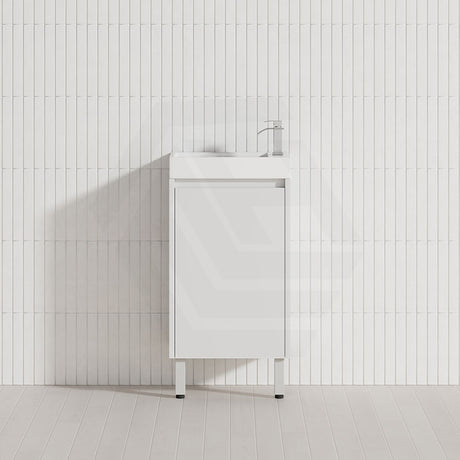
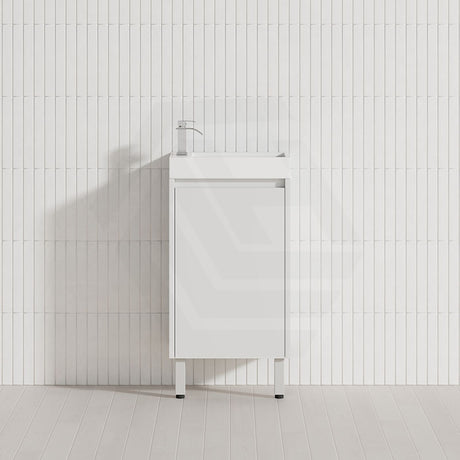
Vanities in the 450 mm and 600 mm width range are the sweet spot for compact bathrooms and should ideally be wall-hung to open up floor space and simplify cleaning. For cabinetry material, PVC board is among the most moisture-resistant options and has become very popular for vanity cabinets. Moisture-resistant MDF is an acceptable alternative, though it requires sealing. Solid timber is also an option but is more vulnerable to moisture damage and demands more ongoing maintenance.
An LED shaving cabinet is a practical way to combine mirror lighting with storage — units start at around $390 and can be recessed or surface-mounted above the vanity without encroaching on bench space. Installation must be carried out by a licensed electrician. A tiled shower niche is another practical storage solution that reduces the need for additional fittings.

Fitting a Bath and Shower in a Small Bathroom
Sometimes a standalone shower and a bath both need to fit within the same compact footprint. With over bath shower screens, you get the full functionality of both a bath and a shower without consuming additional floor area.
Your bath should be at least 1500 mm long to allow comfortable standing and showering. A corner bathtub is another strong choice for limited space — Broadway corner bathtubs range from $958 to $2,085 and come in a range of shapes and finishes. Over bath shower screens are available as hinged bath screens or full-length sliding screens; both contain water within the bath. The bath-adjacent wall must be waterproofed to at least 150 mm above the bath rim, as required under NCC 2022. A compact 3–5 m² bathroom typically takes four to six weeks to renovate from demolition through to final fit-off.
References
National Construction Code 2022, ABCB Housing Provisions, Part 10.2 Wet Areas
National Construction Code 2022, ABCB Housing Provisions, Part 10.8 Condensation Management
AS/NZS 3000:2018 Electrical Installations (Wiring Rules), Standards Australia