02 June, 2026
Modern Powder Room Ideas for Australian Bathrooms
Explore modern powder room ideas for Australian homes. Bold tiles, smart tapware and clever design tips for a stunning guest bathroom.

Video Credit: Home Design Code
What Makes a Modern Powder Room in Australia
The brief sounds simple enough — put in a toilet and a basin, then work out enough space so you don't bang your shin on the wall while going from one to the other. There's no shower, no bath, no bench-top vanity littered with makeup or rolled towels. In terms of spatial and functional complexity, a powder room loses out but makes up for it in design pressure as it's the only wet room of the house which your guests use, and nobody is immune to the power of first impressions.
In my time designing a lot of Australian bathrooms, clients are often the most experimental when it comes to a powder room, and rightly so — the more compact and constrained the overall size and number of items are, the bigger the emotional design response that can be achieved — a large scale tile, a bold tapware finish or just the right vanity in the perfect proportion — without jeopardising any other part of the budget.
In Australia, modern powder room ideas are very heavily influenced by European trends — specifically a strong Milanese preference for large-scale tiles, minimal joinery and metallic high end finishes — but applied in the context of modern-day Australian building requirements, National Construction Code (NCC) compliance and fitting into existing spaces. Most successful are those which have struck the right balance with all three.

Space Planning and Sizing for Small Powder Rooms
Get the size right first — fixtures and fittings can wait until that's settled. A powder room can look a million bucks, yet if people are wrestling with the door or can't reach the basin without contorting themselves, the whole thing falls flat.
900 mm × 1200 mm is the floor area where a new Class 1a dwelling hits its practical limit — workable, just, but nothing more than that. At 1200 mm × 1500 mm, the difference is immediate — both the pan zone and the basin zone have enough clear floor that neither one feels squeezed. Under (NCC 2022, ABCB Housing Provisions, Part 12.2), new builds must provide a 900 mm × 1200 mm clear floor zone in front of the pan and an 820 mm clear door opening — those are the baseline minimums.
Plenty of people don't think about door swing until it's too late. Swing a standard 820 mm hinged door inward in a tight layout and it'll clip the pan or the basin — almost every time. Go with a cavity slider, a barn-style slider, or a door that swings outward — each one buys back usable floor area without altering the room's footprint at all.
A single-wall layout works well in a narrow rectangle — toilet and basin on the same wall means short, tidy plumbing runs. A squarish floor plan calls for an L-shaped arrangement — toilet on one wall, basin on the wall beside it — and the room reads as more open for it. Lift the ceiling to 2700 mm and a tight powder room suddenly feels a lot bigger than its floor plan has any right to suggest.

Materials, Fixtures and Finishes to Think About
Once the layout's locked in, surfaces and finishes move to the front of the queue. Humidity and heavy use demand materials that can take a beating.
There's a solid reason large-format porcelain tiles — 600 × 600 mm or 600 × 1200 mm — have taken off in Australian powder rooms over the past few years. With a water absorption rate under 0.5%, porcelain barely takes on any moisture from humidity or the odd splash. Ceramic tiles sit at $6 to $45 per square metre — a fair bit cheaper than porcelain, which runs $25 to $120 per square metre. That said, ceramic soaks up more moisture — worth thinking hard about in a room that steams up every day.
Matte black leads the pack for tapware finishes in Australian powder rooms at the moment, with brushed nickel and brushed brass close behind. Any of the three works well — the key is carrying the same finish from the basin mixer through to the toilet roll holder, towel rail and robe hook, or the fittings will look like they came from different jobs. Meir and Bella Vista both cover those three finishes well — Meir pitches itself at the premium end at $200 and above, while Bella Vista is the go-to for mid-range spend.
Before buying tapware or plumbing fixtures, check for WaterMark certification (WaterMark Certification Scheme) — without it, a licensed plumber (state plumbing licensing legislation) can't legally do the install. Worth knowing too: lead-free compliance kicks in for all WaterMark certified products by 1 May 2026, so get your fixtures sorted well ahead of time.

Vanity and Storage: Making the Right Call
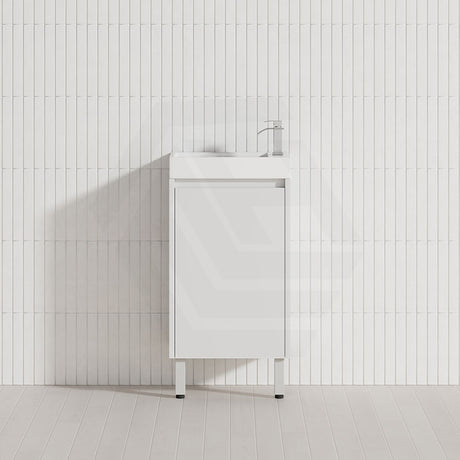
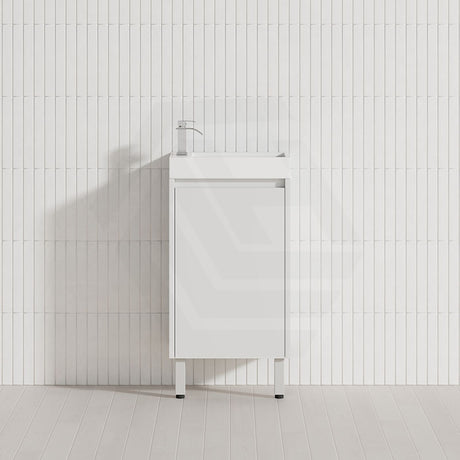
Guests clock the powder room vanity almost immediately — it sets the tone for everything else in the space. A wall-hung vanity somewhere in the 400 mm to 600 mm width range is the sensible pick for a compact powder room. A clear floor beneath the vanity opens the room up visually and makes mopping underneath a non-event.
Depending on carcass material and finish, expect to pay somewhere between $50 and $800 for a wall-hung vanity in that size range. Constant humidity means carcass material is more important than most buyers give it credit for. PVC is the fully waterproof option and takes daily moisture without complaint. MDF offers no real water resistance whatsoever — steer clear of it entirely. Aulic's premium plywood carcasses are structurally solid with clean, crisp lines — pair one with a timber veneer door and the result feels genuinely luxurious. Wall-hung ranges from Lukka and CETO come in widths of 400–600 mm, and most of those options translate well to powder room footprints.
Basin and vanity cabinet — those are two separate line items on the budget. Sit a vessel basin on top of the bench and the visual impact is immediate — tall mixer taps make the pairing even stronger. Where the bench doesn't project far, a semi-recessed basin is the natural fit. For clean lines and minimal upkeep, a fully integrated basin-and-top combination is hard to beat. Price up cabinet, basin, mixer and waste as a package — not in isolation. One drawer is all a powder room really needs — hand soap, a spare roll, a hand towel — and soft-close runners are the kind of small detail guests register without quite knowing why.

Back to Wall or Floating: Your Toilet Options
Two configurations dominate the modern powder room: the back to wall toilet and the floating toilet. Installation complexity and supply cost separate the two considerably.
A back to wall toilet tucks the trapway behind the wall and drops the cistern into a back box or wall cavity — all the working parts stay out of sight. Floor-mounted suites come down to two trap options: an S-trap at a typical 100–120 mm setout, or a P-trap at a 185 mm setout. Your existing floor drain setout dictates which trap works — talk to your licensed plumber before spending a cent. Back to wall suites from Poseidon and Fienza cover a wide price band — supply runs from $185 to $1,199.
An in-wall carrier frame carries all the load for a floating toilet — the pan itself has no contact with the floor. Stack an in-wall cistern at $165 to $1,283 onto the pan at $303 to $934 and the complete wall-hung suite comes to $543 or more — and that's before a tradie sets foot on site. Labour for a floating toilet runs noticeably higher than it does for a floor-mounted unit — factor that in early. The spatial payoff is real, though — a floating toilet claws back 150–200 mm of floor depth compared with a floor-mounted back to wall unit, and the clear floor underneath is a genuine bonus to clean in a tight powder room. There are specific requirements that come with the install, though — don't overlook them.
All sanitary plumbing and drainage connections (AS/NZS 3500.2) must go through a licensed plumber, who should hand you a compliance certificate when the job's finished. WaterMark certification is non-negotiable — every toilet suite, regardless of which one you pick. A 4-star WELS rated suite makes a lot of sense for a modern powder room — 4.5 litres on a full flush, 3 litres on a half flush. Your exhaust fan must clear at least 25 L/s — that's the compliance minimum.
References
National Construction Code 2022, ABCB Housing Provisions, Part 12.2 Livable Housing
WaterMark Certification Scheme, Australian Building Codes Board
State plumbing licensing legislation (VBA Victoria; Fair Trading NSW; QBCC Queensland; Building Practitioners Board WA; CBOS Tasmania; ACTPLA ACT; Building & Energy SA; ABPB NT)
AS/NZS 3500.2 Plumbing and Drainage — Sanitary Plumbing and Drainage, Standards Australia