02 June, 2026
Complete Guide to Luxury Bathroom Design
Discover what makes a bathroom truly luxurious. Our Australian guide covers space, materials, fittings and layout for stunning results.

Video Credit: Reynard Lowell
What Makes a Bathroom Truly Luxurious
The biggest mistake people make with luxury bathroom design is just going with the highest price tag. In my time working with display homes and renovations I've learned that the most luxurious bathrooms share certain measurable traits: space, fittings quality, surface finishes and crucially layout. By layout I mean a layout designed around the space — not the existing plumbing locations that no one ever really considered.
In my view there are five factors when it comes to luxurious bathroom design: space, materials, fittings, technology and budget discipline. Take away any of those five factors and, even if you're spending a lot, you'll never really get a luxurious result. A $4,000 basin in a poorly planned 2.4 m² room will never look or feel luxurious. When it's done correctly, luxury comes down to the feeling you get when you walk into the bathroom — that sense of calm, indulgent escape you're hit with the second you step inside a well-designed space. The five key elements come together when it's done correctly.
In Australia, a bathroom designed to luxurious standards has to comply with NCC requirements and have a wet-area waterproofing system compliant to Part 10.2. Depending on your state you may also need to notify the council. All of these items have a significant impact on expectations, so keep them front and centre at the outset.

Materials and Finishes for a High-End Bathroom
The absolute most important factor in your bathroom in regards to quality and longevity is the surface materials and finishes you're specifying.
For high-end Australian bathroom floors, 600 × 1,200 mm large-format porcelain tile is now the standard everyone's chasing. Porosity is lower than natural stone, and honestly they look brilliant. Go matte or honed and you'll clear the AS 4586 slip-resistance bar in wet areas. Polished finishes? Fine on walls — on wet floor surfaces, forget it. The P-rating simply won't cut it. On a wall, natural marble and travertine look genuinely aspirational — but the upkeep reality hits hard: regular sealing, constant care, and most people aren't prepared for it.
Benchtops, though — that's a whole other story. Engineered stone still dominates vanity tops — non-porous, reliable in pattern, and certain finishes pass convincingly for Carrara marble. Stone resin or genuine marble slabs can make sense on a fully bespoke brief — eyes open though, the cost premium is very real.
Below all of it, waterproofing is what holds the whole thing together. NCC 2022 compliance is non-negotiable here — ABCB Housing Provisions, Part 10.2 is the specific reference. Per (NCC 2022, ABCB Housing Provisions, Part 10.2), shower walls must be waterproofed to 1,800 mm above the floor substrate — bath-adjacent walls need at least 150 mm above the rim. AS 3740:2021 is the compliance pathway the vast majority of projects land on. Cut corners here and you're asking for trouble — membrane failure behind premium stone is a financial disaster.
What tapware finish is Australia buying most? Matt black — and it's not even close. When warmth in metallic finishes is the goal, brushed gold and brushed nickel are the front-runners — Meir and Bella Vista have strong collections across both. Gunmetal grey has real momentum right now — darker than most neutrals, it adds visual depth without going full stark black.

Layout, Sizing and Spatial Planning
A flawless finish counts for nothing when a poor spatial plan leaves people with no room to move.
Aim for at least 4.5 m² of clear floor area in a luxury ensuite — though 6 m² is where it actually starts to feel like you have room to breathe. Cramped shower recesses? That's basically a standard-build tradition. Luxury spec starts at 900 × 1,200 mm; for a frameless walk-in, 1,000 × 1,500 mm is the target — hit 1,500 mm depth and the space genuinely transforms. Wall to pan centre-line: 400 mm is the floor, but 450 mm is the point where it actually feels like enough room.
Get the door swing wrong and suddenly you can't get past the freestanding bath or vanity — it's one of the most common bathroom design blunders. Lock it in before work starts — a door swing change mid-project can drag serious plumbing costs with it.

Signature Fixtures: Baths, Vanities and Toilets
Once the spatial plan is locked in, attention turns to the signature fixtures — the pieces that shape both the look and the budget.
The centrepiece of any luxury bathroom is, unequivocally, the freestanding bath. Broadway is a reliable Australian market staple, with acrylic options for tighter budgets and stone resin for those wanting something more substantial — though a filled stone resin bath tips the scales at around 150 kg, so upper-level installs need a structural check. Lengths run from 1,400 mm to 1,800 mm; drop below 1,500 mm and most adults will find the bathing experience uncomfortably tight. The price spread runs from $878 to $7,182.
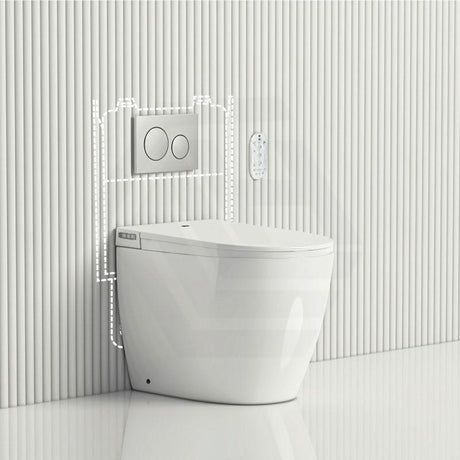
In a luxury ensuite, a double vanity run is pretty much expected. Luxury ensuites typically call for a double vanity run somewhere between 1,200 mm to 1,800 mm. Aulic and CETO both build their high-end vanities on plywood carcasses, which hold up to humidity far better than MDF. What separates a top-tier spec from the rest? Soft-close runners on every drawer, stone or concrete basin tops, and full-extension drawers done cleanly. Wall-hung, rimless pans with an in-wall cistern — the Geberit system leads the market here — free up 150 to 200 mm of floor space and deliver a cleaner architectural result. Take it up a notch with a smart toilet — bidet function, heated seat, auto lid — with Kohler and Fienza covering the range from $1,619 to $6,205. Every toilet suite needs to satisfy WELS water efficiency requirements, so lock in a 4-star rating at minimum. Bear in mind that a smart toilet needs a licensed electrician to connect it within the correct zone under AS/NZS 3000:2018.

Budgeting and Cost Breakdown for a Luxury Bathroom Renovation
With fixtures and finishes sorted, let's get into the budget reality.
Large-format porcelain tile to walls and floor, a frameless glass shower screen, double vanity — entry-level luxury brief will run you between $20,000 and $30,000 across most Australian capital cities. Add a freestanding bath, stone benchtops, a smart toilet, a ThermoGroup heated towel rail, and a decent LED mirror, and the budget climbs to $30,000 to $50,000. Throw in-floor hydronic heating, bespoke cabinetry, natural stone cladding, or premium tapware into the mix, and you're past $50,000 before you know it.
Budgets most often blow out due to a failed waterproofing membrane uncovered during demolition, structural engineer fees for an upper-floor freestanding bath, or electrical work for a heating circuit or smart toilet GPO — that last item runs approximately $400 to $800 for a licensed electrician. Build in a contingency of at least 15 per cent.
Put your money where it counts — tiles, waterproofing, and tapware have the biggest influence on the final result. The LED mirror, heated towel rail, and accessories are good places to pull back — there's a solid range of quality products across different price points.
References
National Construction Code 2022, ABCB Housing Provisions, Part 10.2 Wet Areas
AS 3740:2021 Waterproofing of Domestic Wet Areas, Standards Australia
AS/NZS 3000:2018 Electrical Installations (Wiring Rules), Standards Australia