22 June, 2026
What is a Water Closet?
Discover what is a water closet, how it works, and which styles suit Australian bathrooms best in this complete overview.

Video Credit: TIEIC
But What is a Water Closet?
When you're looking through a quote for your bathroom renovation, reading up on building plans, or trying to find an exact replacement for a broken piece online, odds are you'll run into the term 'water closet' and stop to ask: okay, so what is a water closet exactly?
To put it simply, a water closet is a toilet. The ceramic fixture you sit on to dispose of waste via a flushing water system, without any mystery or need to ask a plumber.
You'll likely see a lot of references to a water closet within Australian building regulations, plumbing documentation, council forms and so on. It's the technical term for the toilet, something that architects, plumbers and building surveyors often use to differentiate it from a basin, bidet or bath. So if you notice WC as a notation within your building plans, you'll know this is your water closet marked in the floor plan — your toilet! Unless you're within a formal documentation setting, it is most commonly referred to as a toilet around Australia, and no one will bat an eyelid.

A Little Bit About Water Closets in Australia
So we have defined what a water closet is — there's also a case for understanding the history of where the fixture evolved from within Australia, as it is this history that dictates the plumbing configurations you will come across within Australian homes, and particularly older homes.
Throughout Colonial Australia, toilets were an outdoor affair — be it an early pan system or a basic pit privy, described by some as a grim affair. Slowly over the turn of the nineteenth to early twentieth century, indoor plumbing came along. Within Australia the standard was to use an S-trap pan with a setout of 100–120mm from the wall to the pipe centre. This is still the most common configuration used today in Australian homes. Where floor drainage was not available, a P-trap pan was used, which connects via a wall outlet at approximately 185mm setout.
The most significant contribution to the history of the water closet was the dual-flush toilet cistern — commercially produced in the 1980s and later legislated in Australia under the Water Efficiency Labelling and Standards (WELS) scheme. This meant people began to think about water consumption in the home. A 4-star WELS-rated toilet uses just 4.5 litres on a full flush and 3 litres on a half flush, compared with the 11-litre single-flush cisterns that were standard for many decades.

How a Water Closet Works: The Key Components
Having read through that history, let's look at the components that make up a modern Australian water closet.
The pan or bowl is the visible component of the water closet — typically vitreous china or ceramic — which collects waste and connects to the drain via the trapway: the integral curved channel that maintains a water seal against sewer gases. It is the trapway design that determines whether the toilet suite you're buying is an S-trap or a P-trap. This is extremely important, especially for a replacement suite.
The toilet cistern stores the flush water, along with the fill valve, flush valve, and float mechanism, and in nearly all mid-range suites and above will feature a dual push button on the lid. AS/NZS 3500.2:2025 sanitary plumbing standards cover drain grading, vent pipe sizing and how waste pipes should be joined — all in the jurisdiction of your licensed plumber.
It's also worth understanding rimless toilets. A classic water closet pan has a rim channel around the inside of the bowl, notorious for bacteria buildup and genuinely unpleasant to clean. A rimless design directs water in a direct sheet around the inside of the bowl — Fienza uses a Tornado flush system to accomplish this. Most mid-range and premium suites have moved towards rimless designs. Once you've cleaned a rimless toilet suite, you will never look back.

Common Water Closet Styles and Configurations
With a working knowledge of the components and how they function together, we can now look at the range of water closet styles and configurations you'll find in showrooms.
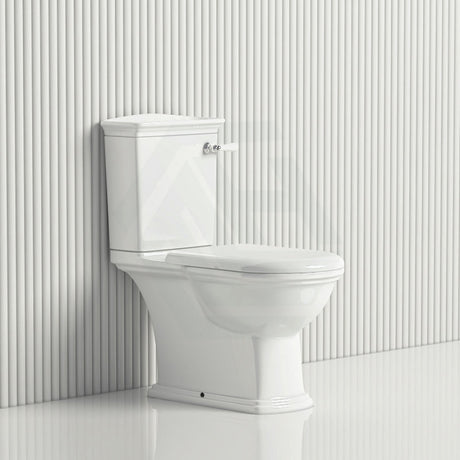
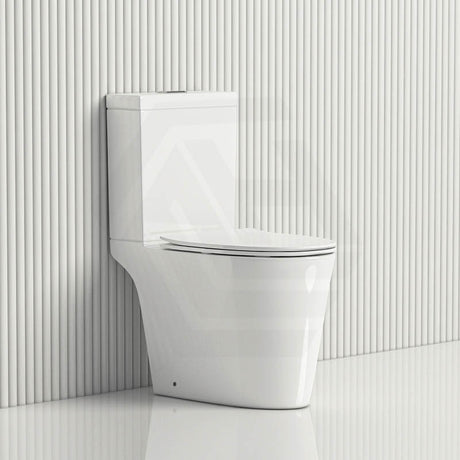
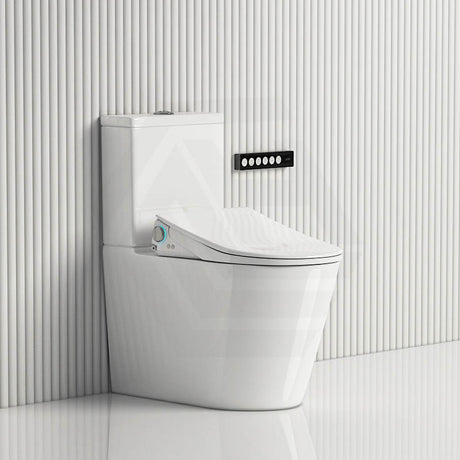
The traditional close-coupled toilet suite has the toilet cistern sitting directly on top of the toilet pan. This is typically what most people picture when they think water closet, and it is generally the most budget-friendly option.
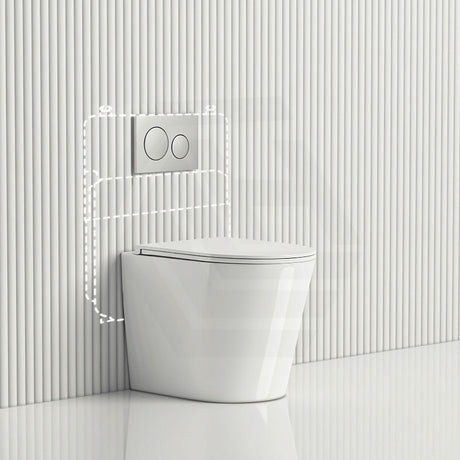
A back to wall wc has the toilet cistern hidden within a wall-mounted cabinet, freeing up floor space and making the room easier to clean. Entry-level back to wall wc suites start at $185 and can reach $1,199 depending on the suite.
A wall-hung toilet suite has the pan suspended above the floor, with the toilet cistern concealed entirely within the wall cavity — in-wall cistern frames are typically from Geberit or R&T for this configuration. Wall-hung suites can be more expensive due to installation and servicing complexity, but the hygiene and space benefits are considerable.

Choosing the Right Water Closet for Your Bathroom
Now let's look at what matters when choosing the right WC suite for your bathroom.
Check whether your existing WC is an S-trap or P-trap and confirm the setout — your new suite must connect to this.
Choose a water-efficient suite. Aim for a 4-star WELS rating or higher (4.5 litres full flush and 3 litres half flush).
Ensure the suite is WaterMark certified.
For budget, entry-level toilet suites run $185–$400; mid-range rimless toilet suites range $400–$800 from brands such as Fienza and Kohler; and premium water closets run $800–$1,199.
If the WC is for an accessible bathroom, the NCC 2025 Livable Housing Design Standard requires a minimum circulation space of 1,200mm by 900mm in front of the pan.
Finally, in every state and territory in Australia, toilet installation must be carried out by a licensed plumber.
References
AS/NZS 3500.2:2025 Plumbing and Drainage — Sanitary Plumbing and Drainage, Standards Australia
AS/NZS 6400:2016 Water efficient products — Rating and labelling (incorporating Amendment No. 1:2022 and Amendment No. 2:2022), Standards Australia
WaterMark Certification Scheme, Australian Building Codes Board
National Construction Code 2025, ABCB Livable Housing Design Standard, Part 3 Internal doors and corridors and Part 4 Sanitary compartment