

19 May, 2026
Standard Bath Size in Australia: What You Need to Know
Discover the standard bath size in Australia before you renovate. Learn key dimensions, depth ranges, and why plumbing rough-ins matter.

Video Credit: W.K.D. Construction llc
What Is the Standard Bath Size in Australia?
Before you fall in love with a gorgeous freestanding bath you've found online, there is one size you should know. The standard bath size for residential baths in Australia is 1500 mm × 750 mm, or 1675 mm × 750 mm. Why are these sizes standard? Because the plumbing rough-in positions in Australia—mainly the waste outlet and overflow—are usually placed during the construction of the house. If you install a bath much longer or much shorter than one of these two standard sizes, you may have to relocate the waste outlet and overflow before turning the taps on.
Depth is another common variable that you should be aware of. Most standard rectangular baths range from 380 mm to 430 mm in depth, which is ideal for comfortable immersion without needing too much change to the level of the bathroom floor.
These two measurements are what we recommend you use as a guide or starting point. Let's take a look at other common bathtub dimensions to find out if a standard bath size is right for you.

Common Bathtub Dimensions and How They Vary
Having established our standard starting point, it's useful to know the range of bathtub dimensions available to help determine whether the standard bath size is right for you.
Bathtub length ranges from the smallest at 1200 mm. While 1200 mm is small, 1500 mm is generally considered the minimum practical bathing length for adults. Bathtub length then ranges from 1500 mm to 1675 mm as a mid-size, then 1700 mm and beyond for a full-size bath. Depth ranges from 380 mm for a shallow bath to as deep as 500 mm for a deep soaker bath. The depth of your bath is going to be very personal and changes the feel of your bath.
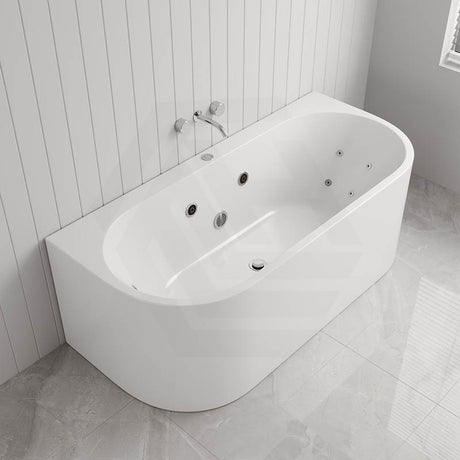
The type of bath also affects the size or footprint. Built-in and back-to-wall baths are usually close to the wall and don't take up much floor space. Freestanding bathtubs need a minimum of roughly 1800 mm of clear floor space around them to give them a sense of style and freedom. Drop-in baths sit within a frame or hob and give a stylish built-in appearance, so this bath type is particularly useful in the alcove. Every type of bath has different bathtub sizes, so it's important to work out what type of bath you want to install before you start measuring the room.

Choosing the Right Bathtub Sizes for Your Bathroom Layout
We know the common bathtub sizes, now let's look at the other part of the equation—how your specific bathroom layout determines which of those sizes will physically fit.
A simple rule to remember is to keep a minimum 700 mm of clear access on the long entry side of the bath. That side is the side bathers usually step over to get in, so keeping the walkway space clear is vital for an enjoyable bath experience. Remember, door swings, vanities, and wet areas quickly reduce the amount of usable bathroom floor space. Under NCC 2022 Livable Housing provisions, any new bathroom doorway also needs to be a minimum 820 mm (NCC 2022, ABCB Housing Provisions, Part 12.2) clear opening — something you'll want to double-check if you're moving your bathroom door.
Finally, an important tip: cut a cardboard template of the bath's footprint and place it on your bathroom floor. Leave it there for a day. Get used to walking around it. Open the door. Imagine standing in it on a cold winter morning. It will save you a fortune.

Corner Baths: A Smart Solution for a Small Bathroom with Bath
If neither an alcove nor freestanding position is going to work for your bathroom layout, using a corner bath is often the most practical way of including a bath without losing too much floor space.
Placing the bath in the corner allows you to reclaim the diagonal space that you can't make use of in a typical rectangle. Bath footprints are commonly 1200 mm × 1200 mm to 1500 mm × 1500 mm, and placing a bathtub in corner position opens up the central floor area significantly. That's enough to transform a small bathroom with bath from claustrophobic and crowded to functional and comfortable. In addition, the triangular or angled bath shape makes for excellent soaking capacity.
When comparing corner bath tubs, the cost for an acrylic corner bath ranges from $958 to $2,085 in Australia. Broadway and Poseidon are reliable brands within those price brackets. Corner bath tubs fit well in bathrooms with an L-shaped footprint or where a corner is cut off by a window. The downside is that the plumbing may need to be moved, meaning a licensed plumber will need to be engaged to complete the work.

Key Measurements and Installation Considerations Before You Buy
Regardless of the style or size of the bath, some important measurements and installation details need to be considered before buying.
First, measure your doorways and access corridors — if you're ordering a bath 1700 mm long, it needs to be brought into the home before being positioned on the floor. You'll also need to determine if the floor is load bearing. A cast iron or stone resin bath is substantially heavier than an acrylic bath, and sometimes the floor frame in older homes needs to be strengthened. A small corner tub in acrylic has a far lower load on the existing floor than a similar sized stone resin bath.
The bath perimeter must be fully waterproofed to meet Australian standards. This involves waterproofing a minimum of 150 mm (NCC 2022, ABCB Housing Provisions, Part 10.2) (AS 3740:2021) above the bath rim on the walls adjacent to the bath, and the floor to wall junction needs to be detailed appropriately. These steps must all be performed by a licensed waterproofer. The plumbing for the waste, overflow, and water supply must all be connected by a licensed plumber, and a certificate of compliance is required on completion. This applies in every state and territory in Australia.
If you're replacing a like-for-like bath and not moving the plumbing or retiling, the installation cost is typically around $500 to $1,500. This will increase if the plumbing needs to be shifted. Having this information is essential before you begin the project to stay within your renovation budget.
References
National Construction Code 2022, ABCB Housing Provisions, Part 12.2 Livable Housing
AS 3740:2021 Waterproofing of Domestic Wet Areas, Standards Australia
National Construction Code 2022, ABCB Housing Provisions, Part 10.2 Wet Areas
State plumbing licensing legislation (VBA Victoria; Fair Trading NSW; QBCC Queensland; Building Practitioners Board WA; CBOS Tasmania; ACTPLA ACT; Building & Energy SA; ABPB NT)