05 May, 2026
Small Bathroom with a Bath: Layout Ideas for Compact Spaces
Small bathroom with bath: practical layout ideas, minimum sizing and space-saving configurations for compact Australian homes. Discover how to fit a bath without sacrificing comfort or style.

A Bath in a Tiny Bathroom — Is It Actually Doable? What the Minimum Sizes Actually Mean
"Can I fit a bath in here?" — hands down, that's what I hear most from people mid-reno on a small bathroom. Short answer: yes — though you'll want to get your head around the minimum sizes before anything else.
If you want a bath, 1500 mm in bathing length is the bare minimum for an adult. Any smaller and the experience becomes genuinely uncomfortable. Bath sizes usually run from 1500 mm through to 1675 mm and 1700 mm (standard sizes), with compact options from 1200 mm to 1400 mm. Compact baths are generally suitable for a children's bathroom or an occasional-use ensuite that is not the primary bathroom. To fit a 1500 mm bath with adequate clearance, the minimum floor footprint for the bathing zone alone is 900 mm × 1800 mm, not including vanity, toilet, and door swing.
Under NCC 2022, new Class 1a dwellings built to Livable Housing Design requirements must also provide an 820 mm clear door opening (NCC 2022, ABCB Housing Provisions, Part 12.2) and a 900 mm × 1200 mm clear zone in front of the toilet. A small bathroom with bath has limited floor area, so these clearances compound quickly and make layout more difficult. It is essential to understand your actual room dimensions and the minimum sizes your room must meet before making any fixture decisions.
Once you know the minimum sizes for your bathroom, the next decision is how to arrange the bath within that space. Layout has the biggest impact on how functional the room feels day to day.

Best Layout Options for a Small Bathroom with Bath
Layout is everything in a small bathroom with bath. Even if your bathroom looks gorgeous, no one will enjoy a room that is poorly laid out, no matter what tiles and finishes you choose.
There are four practical configurations for a compact bathroom:
Alcove bath — the most space-efficient option. The bath sits between three walls, typically 1500–1700 mm long, with no wasted clearance space beside the fixture. Plumbing is straightforward and the footprint is predictable.
Corner bath — suits rooms that are wider than they are long. Broadway and Poseidon offer corner baths with a 1200 mm × 1200 mm footprint, keeping the centre of the room clear.
Bath-over-shower combination — the most practical small bathroom ideas for households needing both functions without the floor area for separate fixtures. The shower waste sits within the bath footprint, a frameless shower screen encloses the space, and the room functions as both simultaneously.
Single-wall layout — bath, vanity, and toilet arranged along one wall with circulation space opposite. This works well in narrow rooms of 1500–1700 mm width and keeps plumbing consolidated, reducing installation costs.
The materials and fixtures you specify will then determine whether the room feels cramped or surprisingly open.

Materials and Fixtures That Actually Save Space in a Small Bathroom
Large-format tiles? In a small bathroom, they're absolute workhorses. Cut the grout lines and you cut the visual clutter — lay a 600 × 600 mm or 600 × 1200 mm porcelain tile across the floor and up the walls, and that room will read as a fair bit bigger than it is. AS 4586 requires floor tiles to meet P-rating slip resistance — matte-finish porcelain earns its place here, typically landing at P4 or P5, which is right where you want to be for wet areas, and it still looks sharp.
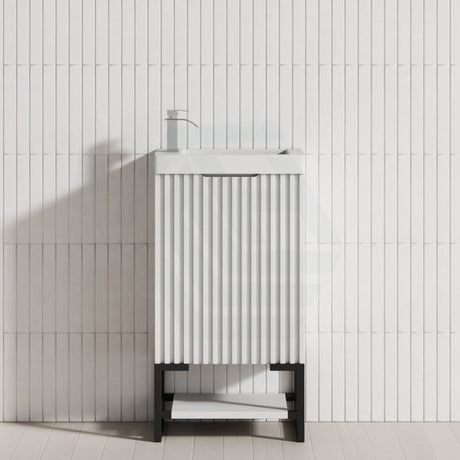
Lift the vanity off the floor and suddenly there's breathing room down there — mopping's a breeze, and the storage doesn't disappear. The Lukka wall-hung vanity sits at 400–500 mm wide — a proper basin with storage, and it doesn't touch your floor space. A wall-hung pan shaves around 150–200 mm off the forward projection versus a floor-mounted suite — in a tight bathroom, that's not nothing.
Ditch the frame on your shower screen — the sightline stays open and there's no door arc eating into the room. Your toiletries don't need to crowd the room — cut a niche into the wall and everything sits flush, out of the way.
These small bathroom design ideas are specification-level decisions that deliver quantifiable benefits. In a windowless bathroom, NCC 2022 requires mechanical exhaust ventilation at a minimum of 25 L/s. Speak to your builder early if the exhaust is venting into the ceiling cavity of the floor above, as this can create issues in the roof structure.

Which Small Bathtub Will Fit in a Small Bathroom?
The type of small bathtub you choose is just as important as its length, as it directly affects the small bathroom design, structure, and cost of your build.
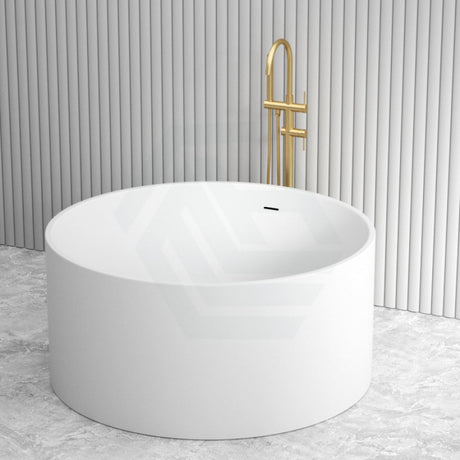
Drop-in baths are set into a tiled frame and are the most affordable option, ranging from $312 to $1,184 AUD. The tiled frame can double as a seat or shelf, which is useful in small spaces. Back-to-wall baths face into the room with the overflow and plumbing concealed within a tiled panel, offering a sleeker finish suited to small bathroom design ideas. Prices range from $938 to $2,085 AUD. A tiny freestanding bath starts from $878 AUD but requires a minimum of 1800 mm of clear floor space around it — in most small bathroom with bath situations, this is only achievable when the room allows clearance in at least one direction.
On materials: acrylic offers good heat retention and is significantly lighter than stone resin. Stone resin baths weigh 90–120 kg before water load. Confirm with a structural engineer before ordering a stone resin bath, as upper-floor installations often require structural reinforcement.
Broadway offers a strong range of drop-in and back-to-wall baths suited to compact rooms. ABS and CETO have good selections of compact freestanding bath profiles if that is the format you need. If you are considering a 1500 bath tub, note that this is the minimum practical adult bathing length — compact baths at 1200–1400 mm serve a different purpose and should not be treated as equivalent.

Installation Considerations and Common Mistakes to Avoid
The most common mistake in a small bathroom with bath is ordering the bath before the position is confirmed. With a 1500 bath tub, there is no margin to reposition the floor waste penetration once it is core-drilled. If the hole is in the wrong location, the slab must be drilled again at a cost of $500–$1,500 AUD. Ensure there is a minimum 600 mm access clearance beside the bath on the side where the waste and overflow are located, for the licensed plumber's safety. Work this out on the floor plan before finalising the bath position.
Waterproofing must be completed before the bath is installed. Under AS 3740:2021 as adopted in NCC 2022, all bath-adjacent walls must be waterproofed to a minimum of 150 mm above the bath rim (NCC 2022, ABCB Housing Provisions, Part 10.2) (AS 3740:2021), and the wall-to-floor junction must be flashed at least 40 mm horizontally. Installing the bath before waterproofing is complete will require the entire installation to be removed and redone. Beyond waterproofing, there are plumbing requirements to keep in mind as well.
Under AS/NZS 3500.4, the 50°C maximum bathroom outlet temperature (AS/NZS 3500.4) applies — factor this in when selecting your bath filler and taps. All waste, overflow, and water supply connections must be completed by a licensed plumber. In most Australian states and territories, waterproofing must also be completed by a licensed waterproofer. Any electrical work — lighting, exhaust fans, shaver cabinets — must be completed by a licensed electrician. None of this work can be self-certified in any Australian state; all trades must be licensed.
References
National Construction Code 2022, ABCB Housing Provisions, Part 12.2 Livable Housing
National Construction Code 2022, ABCB Housing Provisions, Part 10.8 Condensation Management
AS 3740:2021 Waterproofing of Domestic Wet Areas, Standards Australia
National Construction Code 2022, ABCB Housing Provisions, Part 10.2 Wet Areas
AS/NZS 3500.4 Plumbing and Drainage — Heated Water Services, Standards Australia