14 May, 2026
Art Deco Bathroom: Glamorous Design Tips and Inspiration
Transform your art deco bathroom with bold geometry, rich contrast and layered ornamentation. Australian design tips and inspiration.

Video Credit: Nicole Rudolph
Key Characteristics of Art Deco Bathroom Design
I find that few design movements have a greater impact in the bathroom than Art Deco. This movement started in Europe back in the 1920s and has never gone away, as I often see it at international design fairs year on year, always being re-interpreted and reimagined with increased confidence. What makes Art Deco work so well is that its principles are clear, including geometric symmetry, bold tonal contrast, and detailed and layered ornamentation.
In terms of how the style applies to the bathroom, those clear principles apply to practical decisions as well. If your vanity unit has a mirror above it, that mirror should sit perfectly centred and not offset to one side. The tiles you install should match the geometry of the bathroom, so a herringbone or chevron tile laid at an angle in the middle will look out of place. The fixtures need to be placed evenly too, so wall lights on both sides of the mirror will always work for an art deco bathroom, whereas a single light hanging from the ceiling will not.
There is also a distinct difference between Art Deco and the style that sits right next to it, which is mid century modern. A mid century modern bathroom leans toward curved organic lines, teak timber accents, and more muted and warmer colour palettes. It does not have the same bold colours, polished surfaces, and gold or chrome metallic accents. It is good to understand that difference early on when choosing tiles and fittings, as they are very different things.
Once you understand the geometry and symmetrical elements that make up this style, you then need to start looking at the colours and finishes.

Materials, Tiles, and Colour Palettes for an Art Deco Bathroom
The look and feel of an art deco bathroom, especially the materials and fixtures, is very well defined, featuring polished marble or marble-look porcelain tiles, black-and-white and geometric encaustic tiles, chrome or brushed gold fixtures and taps, and painted or high-gloss joinery. Each of these is available in Australia and you can find them at different price points.
When it comes to the tiles, wall tiles tend to be laid in a 200×200 mm format as the geometric shapes and grid-like look are an integral part of Art Deco bathroom design ideas. On floors though, polished finishes will not work and will cause safety issues as well. Wet area floor tiles need to meet the Australian slip resistance standards under AS 4586, and a standard polished finish will often not comply. Specify a honed or matte finish for floors and reserve the polished surfaces for walls where the visual drama is needed most. In compact ensuites under five square metres, it is wise to restrain geometric patterning to a single feature wall rather than tiling every surface.
When it comes to the colour palette, it is not too complicated. Stick to a monochrome palette with blacks, whites, and warm greys — this is probably the safest and most historically accurate starting point. Adding a jewel tone from a feature tile or an accessory can add some depth without making it too overwhelming; emerald green and deep navy both work well. Adding gold to accessories like towel rails, taps, and door handles also works with this style. Brushed Gold tapware from Meir, for example, sits in the $200 to $456 range for basin mixers and delivers that warm luxury finish the style requires without the maintenance concerns of polished gold plating.
Now that your palette is settled, the bathroom feature wall can become your canvas — and it is also where your installation technique really matters for both design and durability.

Art Deco Bathroom Feature Wall: Ideas and Installation Tips
The bathroom feature wall is key to bringing an art deco bathroom to life. Fan or scallop tiles, chevron patterns, and geometric glass mosaics — such as hexagonal ranges from Onix — are all suitable period options and can be seen as you walk in. Eye level is important here, as the bathroom feature wall should be one of the first things that greets your eye upon entering the room.
Before you choose the tile, you first need to get the substrate right. For shower walls, the waterproofing membrane must extend at least 1,800 mm (NCC 2022, ABCB Housing Provisions, Part 10.2) above the floor substrate, and wall-to-floor junctions require a horizontal flashing leg of at least 40 mm. Compliance is commonly achieved by way of AS 3740:2021, which your waterproofer will refer to. Never cut corners here; the cost of replacing the membrane behind luxury feature tiles is considerable. The waterproofing membrane also requires 24 to 48 hours of cure time before tiling can begin — do not allow tiling to proceed before that window has passed.
Choosing the grout colour makes all the difference to the final result. A dark grout with white tiles will highlight the grid — a classic Art Deco aesthetic choice. A lighter colour can help soften the effect. On polished or glass mosaics, grout haze is a possible problem; consider an epoxy grout or confirm your tiler has experience using it.
One common error with a bathroom feature wall is beginning the layout in the wrong place. Always establish a centred grid first and work outward from there, particularly with fan or chevron tiles where symmetry must be maintained. An off-centred start can be very visible in the finished result.

Vanity and Storage: Choosing the Right Cabinetry
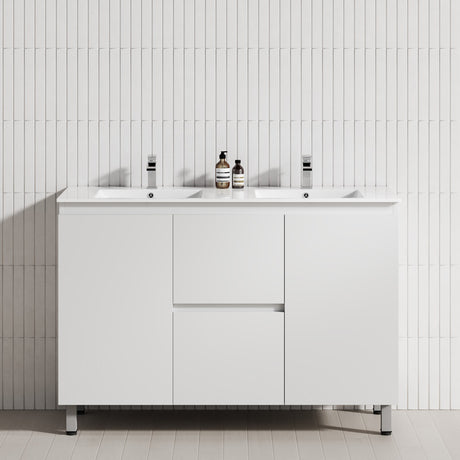
The vanity you choose for your Art Deco space must look like it fits the style but also work day-to-day. Standard widths are 600 mm, 750 mm, 900 mm, and 1,200 mm. Determine which size fits your bathroom floor plan before choosing a style. In a large bathroom, a double-basin 1,200 mm vanity can look luxurious, but in a smaller ensuite, a 600 mm wall-hung vanity with simple lines will feel most cohesive.
Timber or timber-effect cabinetry pairs beautifully with the warm contrasts that define Art Deco design. A wood bathroom vanity featuring brass hardware or fluted legs instantly echoes the era's love of rich textures set against cooler stone and polished chrome. If you need to keep costs down, a timber bathroom cabinet with a PVC-laminated MDF core can look convincing at a much lower price point and may actually be more resistant to humidity than solid wood. For a step up, a hardwood bathroom vanity offers genuine durability and a premium finish that holds up over ten or more years under normal bathroom use.
Aulic and CETO both stock wall-hung vanities in woodgrain finishes with plywood carcasses that retail for $1,200 to $2,828. At this price point, soft-close hinges and runners are expected and add genuine longevity to the cabinetry.

Fitting It All Together: Fixtures, Fittings, and Budget Breakdown
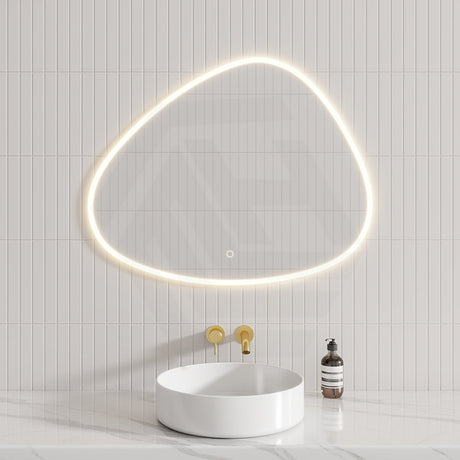
Having a clear budget breakdown helps greatly when planning an art deco bathroom. At the entry level, between $8,000 to $12,000, an Art Deco look is achievable using geometric-pattern porcelain tiles, a mid-range vanity, chrome tapware from Fienza or Bella Vista, and a framed oval mirror. With more budget, between $15,000 to $25,000, you can include brushed gold tapware, glass mosaic feature tiles, a premium vanity with plywood construction, and an oval LED mirror priced between $246 to $734. For a more extravagant result, $30,000-plus budgets allow for natural-marble-look stone surfaces, a Broadway freestanding bathtub — which requires at least 1,800 mm of clear floor space and starts at $878 — and a complete matching set of brushed gold accessories, from towel rails and toilet-roll holders to robe hooks.
Electrical fixtures such as LED mirrors and heated towel rails must be hard-wired by a licensed electrician and protected by an RCD in line with AS/NZS 3000:2018; ThermoGroup heated towel rails are a reliable option at this tier. For tapware, ensure every product is WaterMark certified before your plumber begins installation. Finally, keep all metallic accessories in a single finish — everything in brushed gold or everything in chrome is the key to achieving a resolved art deco bathroom that genuinely evokes the style.
A mid-range art deco bathroom renovation typically runs eight to twelve weeks from demolition to completion, and custom-ordered vanities from local suppliers carry a four to six week lead time, so factor that into your schedule early.
References
National Construction Code 2022, ABCB Housing Provisions, Part 10.2 Wet Areas
AS 3740:2021 Waterproofing of Domestic Wet Areas, Standards Australia
AS/NZS 3000:2018 Electrical Installations (Wiring Rules), Standards Australia
WaterMark Certification Scheme, Australian Building Codes Board