14 May, 2026
Hamptons Bathroom: How to Achieve This Classic Coastal Look
Want a hamptons bathroom? Discover the key elements — shaker cabinetry, coastal colours and natural textures — in this Australian style guide.

Video Credit: Suzie Anderson Home
Understanding What Makes a Hamptons Bathroom
It's not a surprise that the hamptons bathroom remains the most frequent client brief I receive from across Australia. It is not a trend, as matte black or terrazzo were, but a distinct look with staying power. It is based around a few key principles: clean lines, high quality materials and the ability to create a space where you feel that you are close to nature and the coast.
A classic hamptons style bathroom can be created with: white or soft off-white painted cabinetry with flat, recessed shaker-style doors; white-beaded or shiplap style wall panelling to one or more walls; textures from timber, linen and stone; and colours inspired by the coast, including various shades of white and grey, warm sand tones and the odd touch of navy. There is a distinct difference between a classic hamptons style bathroom and a generic coastal bathroom ideas space — the difference is all about detail. Moulding profiles, choice of hardware, tile sizes, every element must be carefully considered in order to produce a successful result. It is not about putting on some white paint, adding some rope accessories and calling it Hamptons. From the beginning, you must carefully choose all materials and finishes, and stick to this style.
Once we understand what makes up a hamptons bathroom look and style, it is important to identify the exact products and finishes required to bring these elements to life, and their respective price points in Australia.

Key Materials and Finishes for a Hamptons Bathroom
Hamptons bathroom cabinetry is usually painted MDF at mid-range pricing, or high quality plywood if you are creating something to last, and you want to ensure it is the most moisture-resistant and stable material. Plywood is worth its added cost in bathroom cabinetry; it holds screws better and withstands moisture much better than MDF, and can be painted well. A white porcelain subway style tile is the standard for hamptons bathroom walls in Australia — either 75×300mm or 100×300mm size — or you can get a marble-look porcelain if you would like a more elevated look. Porcelain is the correct specification, and not ceramic — its lower porosity means that it is far more durable in the wet conditions of a bathroom. This is particularly relevant for wall tiles to the shower recess.
Marble or high quality marble-look porcelain benchtops are great for creating the classic Hamptons style in your bathroom at a fraction of the price of real stone. Beyond the surfaces you can see, the substrate work underneath is just as important. Any bathroom renovation including a shower recess must adhere to waterproofing (AS 3740:2021) requirements under NCC 2022, ABCB Housing Provisions Part 10.2, and AS 3740:2021. Shower walls must be waterproofed to a minimum of 1800mm above the floor substrate (NCC 2022, ABCB Housing Provisions, Part 10.2), and this must be undertaken by a licensed waterproofer before tiles are installed. Allow 24 to 48 hours cure time between waterproofing coats before tiling begins. A typical hamptons bathroom renovation runs four to six weeks from demolition to completion. Don't cut corners on these details just to keep it under budget.
For the hardware, the two most natural Hamptons finishes are brushed nickel and chrome. Warm metals such as brushed brass can work well in some interpretations of contemporary Hamptons, however the more authentic choices are chrome and brushed nickel.

Layout, Sizing, and Practical Planning Considerations
Choosing the right vanity is only half the battle. The next step is to determine the correct fit for your space. You want a bathroom that looks planned out and not cramped or cluttered.
In my experience of designing bathrooms in different sized houses, I'm always seeing homeowners trying to squeeze too much into a bathroom. A 1500mm Hamptons double vanity in a 2.4×2.1m ensuite is going to look terrible. The same size vanity would be perfectly proportioned in a larger main bathroom that is 4×3m. As a general guideline, vanity width recommendations run from 600mm for compact single-basin configurations up to 1500mm for generous double-bowl formats, and the clearance between the vanity front and any opposing wall or fixture should not fall below 900mm for comfortable use. For a rental property Hamptons renovation, a minimum vanity width of 750mm single or 900mm double is a practical starting point.
A freestanding bathtub — one of the signature centrepiece elements of a hamptons bathroom — requires a minimum of 1800mm clear floor space around it to function and photograph well. If your bathroom cannot accommodate that comfortably, a back-to-wall bath is the more considered decision. Forcing a freestanding tub into an undersized floor plan is one of those choices that looks compromised from the moment it is installed.

Choosing the Right Bathroom Vanity
You now have a good idea of what style vanity you need and what measurements you have available for your space. Choosing the right hamptons bathroom vanity should be much easier now that you have the correct measurements.
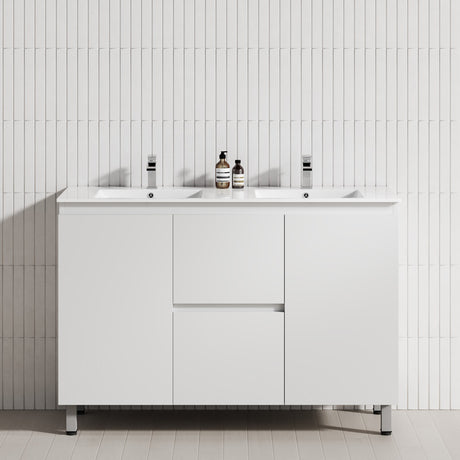
Hamptons style bathroom vanities are most often freestanding, with visible legs, shaker-door profiles, and a painted finish in gloss or matt white. These are available in Australia from around $238 through to $1,378 depending on construction quality and width. Wall-hung units in white gloss or a warm wood grain suit contemporary Hamptons interpretations and are available from $409 to $2,828 for higher end 1500mm options.
Aulic makes Australian-made plywood construction vanities that work well for this style. CETO offers options including Häfele German hardware and a gloss white painted finish.
To browse the full range and compare shaker profile and freestanding formats side-by-side, visit the Hamptons vanities collection. For double-bowl configurations, the Hampton bathroom vanities range offers widths from 900mm to 1500mm. If a wooden bathroom vanity appeals, carry that timber finish through to the mirror frame or a floating shelf so the material reads as intentional rather than incidental. Note that vanities nearly always arrive without a basin mixer and waste — budget these separately.

Tiles, Fixtures, and Fittings: Completing the Look
Now the vanity has been decided upon, it is time to select the remaining tiles and fixtures that will work in relation to the style and specification of that piece.
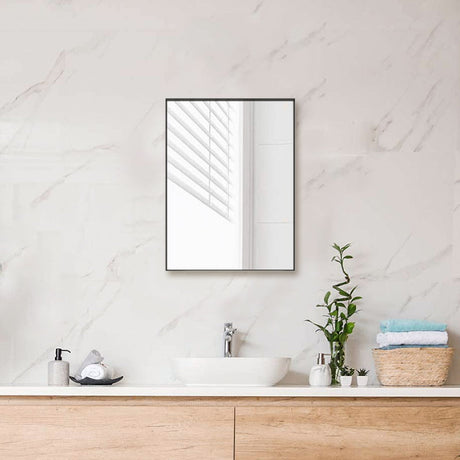
The floor should have a porcelain finish with a matte surface, as polished tiles do not comply with wet area slip resistance requirements under AS 4586. Use white subway tiling on the walls, and select a shower floor design of hexagon or penny-round mosaic tiles. Select a mirror framed in white or a simple timber profile to finish off the look. Consider tile format in relation to bathroom size — a 75×300mm subway tile is a compact format that suits smaller rooms, whereas a larger format in the same space creates an excess of grout lines that works against the clean lines of the Hamptons aesthetic.
All tapware must be WaterMark certified (WaterMark Certification Scheme) — a licensed plumber will not install product that lacks this certification. Both Fienza and Meir offer chrome and brushed nickel tapware ranges at various price points that suit hamptons bathroom ideas well. Accessories such as towel rails, toilet roll holders, and robe hooks should be 304 stainless steel in chrome or brushed nickel, as these are suited to high humidity environments. Every accessory should match the tapware finish exactly — consistency in this area is one of those details that separates a considered design from a piecemeal assembly.
LED mirrors and heated towel rails must be installed by a licensed electrician and must have RCD protection (AS/NZS 3000:2018) in accordance with AS/NZS 3000:2018 — this is not a DIY task. Once the compliance boxes are ticked, the coastal bathroom ideas that work best in Australian homes are those executed with the discipline of selecting finishes as a palette rather than as individual product choices. With that discipline applied, the resulting space will be cohesive and considered — the kind of hamptons bathroom ideas outcome that produces a room you would genuinely want to live in.
References
National Construction Code 2022, ABCB Housing Provisions, Part 10.2 Wet Areas
AS 3740:2021 Waterproofing of Domestic Wet Areas, Standards Australia
WaterMark Certification Scheme, Australian Building Codes Board
AS/NZS 3000:2018 Electrical Installations (Wiring Rules), Standards Australia