

14 May, 2026
Mid Century Modern Bathroom: Design Ideas and Inspiration
Explore mid century modern bathroom design ideas, colour palettes, and styling tips to create a timeless, functional space.

Video Credit: Studio McGee
What Defines a Mid Century Modern Bathroom
Mid century modern bathrooms haven't actually gone out of style. This particular design style emerged during the decades between the 1940s and 1960s. It is typified by the use of straight, horizontal lines, rounded organic curves, a lack of fussy details, a belief that form follows function, and the resulting aesthetic is still equally contemporary today. A mid century modern bathroom is inspired by American domestic architectural design, and refined by the Scandinavian industrial design aesthetic. It is both soothing to look at, and extremely functional.
To understand this mid century modern bathroom style, it can be helpful to imagine it on a line between more commonly understood bathroom styles. An art deco bathroom is all about glamorous geometric shapes, high contrast with sharp edges, a very symmetrical layout, and elaborate detailing. A scandinavian bathroom is the polar opposite; it emphasises natural materials, pared back styling, and an overall aesthetic that supports a hygge lifestyle. A mid century modern bathroom sits somewhere between those two: a less minimal interpretation of a scandinavian aesthetic without the ornamentation of art deco design, with a strong grounding in honest materials.
For a bathroom, mid century modern style means cabinet joinery mounted on tapered or hairpin legs, warm timber cabinetry and door joinery, with finishes in either a matte or satin finish rather than a high gloss one. Additionally, bathroom fittings like basin, shower, and cabinet handles will be rounded, rather than hard-edged. When I walk into a bathroom and someone asks me what style it is, I immediately look at the detail of the vanity legs, the finish and format of the tiles, and the finish of the fixtures and taps. Get those three elements right, and the room should look like a mid century modern bathroom.

Key Materials and Finishes for a Mid Century Modern Bathroom
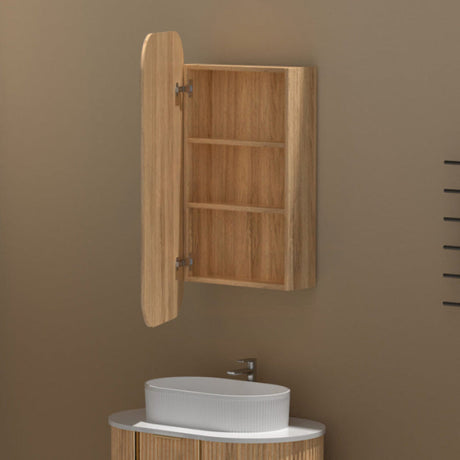
There are certain finishes, as well as certain materials, used for mid century modern bathrooms which require thought, and it is helpful to consider each one individually. Cabinetry joinery is timber based, usually a veneer of teak or walnut, or solid teak or walnut. In the bathroom, as a wet space, all cabinetry joinery must be waterproof, moisture resistant, and highly durable. A good way to achieve this is to build all cabinetry out of cabinet-grade plywood, then veneer that plywood with a real timber veneer. This produces a very durable product with real, natural grain variation that cannot be replicated by MDF wrapped with a printed timber-look vinyl film.
Tiles are a separate matter entirely. Terrazzo — either genuine or porcelain terrazzo-look — is the period-correct material choice for flooring. The terrazzo-look porcelain tile range available nowadays is a high-quality and very durable option, with lower porosity than ceramic. Mosaic tiles in 75×75mm format work well on shower floors and feature walls. A more cost-effective option is matte ceramic in a 300×300mm format, which maintains the low-sheen quality essential to the MCM palette. The most common error I see is introducing high-gloss large-format tiles that are reflective and immediately spoil the warm feeling of the rest of the room.
For tapware and accessories, brushed brass or brushed gold is the primary finish choice, with matte black as a sharper, more contemporary alternative. These are tapware and accessory finishes — not cabinetry options — and that distinction matters when specifying a project. Keep the palette honest: warm timber tones pair with brushed gold; cooler grey-toned joinery pairs with matte black.
Before any waterproofing and tiling is done, the wet area membrane must comply with NCC 2022, ABCB Housing Provisions, Part 10.2, with shower walls waterproofed to a minimum 1,800mm above the floor substrate. Compliance is generally managed via AS 3740:2021 as the alternative pathway — your waterproofing contractor will be familiar with both.

Layout, Sizing, and Practical Design Considerations
Don't start picking the tile and tapware finish until the floor plan is finalised. There must be a minimum of 900mm clearance in front of the vanity, and 750mm minimum between fixture faces under AS 1428.1.
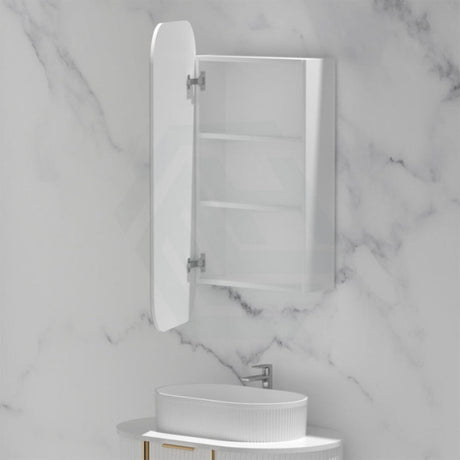
To maintain mid century modern proportion and feel in bathrooms under 4m², a wall-hung vanity makes all the difference. A vanity that reveals the floor beneath it feels light compared to one that sits on the floor. For storage, use a recessed niche with built-in timber shelves, and a push-to-open door or hidden storage in the vanity cabinet rather than a separate rail.
If there is no window, ventilation must be a minimum of 25 L/s under NCC 2022 and must be finalised before the cabinetry or ceiling is installed.
Other practical modern bathroom ideas suited to this style include a floating teak shelf above the basin, a shower niche tiled in mosaic, and concealed storage inside the vanity cabinet.

Selecting a Mid Century Style Bathroom Vanity
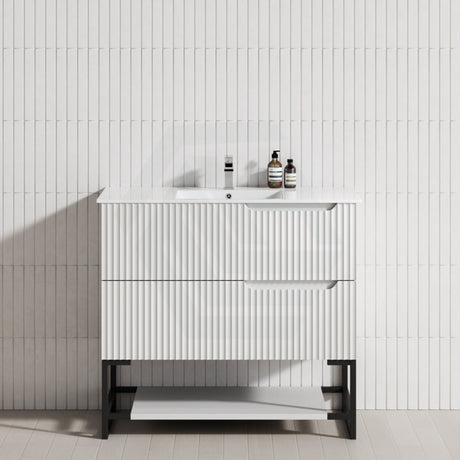
Deciding on a midcentury bathroom vanity is often the most important step. Tapered timber legs or hairpin legs in brushed brass work perfectly and are in keeping with a mid century style bathroom vanity.
A mid century modern bathroom vanity is typically available in 600mm, 750mm, 900mm, or 1200mm widths. For a single-person bathroom, 750mm provides enough useable bench space without dominating the room. For a double-basin master ensuite, 1200mm is appropriate. Mid century modern bathroom vanity cabinets are generally constructed from a plywood carcass with a timber veneer door, as these last longer than MDF over the medium to long term.
A wall-hung unit requires solid timber noggings or a masonry wall to carry the weight of the cabinet and bracket. A freestanding cabinet on legs is easier to install and suits older walls. Both Lukka and Aulic offer a mid century modern bathroom vanity as a freestanding cabinet with legs. A mid century style bathroom vanity is priced between $238 to $1,378 AUD depending on width, material, and drawer configuration. Note that the vanity price does not include a basin mixer or waste, which are sold separately. Basin mixer installation must be carried out by a licensed plumber.

Lighting, Fixtures, and Finishing Details
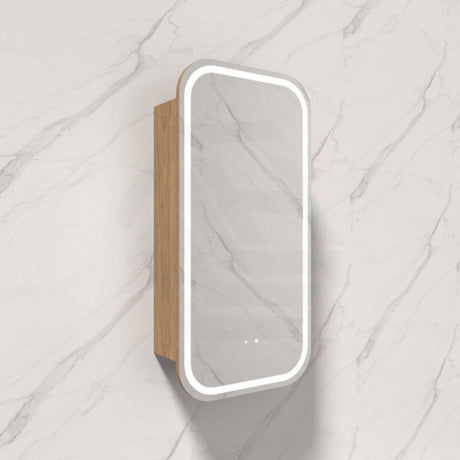
A task light at the mirror needs to provide 500 lux per AS/NZS 1680. A pendant globe or linear bar light in a warmer tone suits a mid century modern bathroom. Select 2,700 to 3,000 Kelvin colour temperatures to retain warmth in the timber. Do not use a colour temperature above 4,000 Kelvin, as timber joinery can appear greyed out under cooler light — particularly in bathrooms without natural light, where 2,700K is the preferred setting. An LED mirror with dimmer and anti-fog functionality costs from $178 to $734 AUD and must be hardwired by a licensed electrician to comply with AS/NZS 3000:2018 bathroom zones.
A good quality basin mixer will pull all the design elements together. A timber vanity in a warmer walnut colour combined with a brushed gold basin mixer from Fienza or Meir fits well in a mid century modern bathroom. Both Fienza and Meir supply WaterMark-certified basin mixers, as required for all tapware installed in Australia. A contemporary basin mixer produces between 6 to 9 litres per minute. Match the finish to your heated towel rail, toilet roll holder, robe hook, and mirror frame. ThermoGroup supply a heated towel rail in a brushed gold finish that complements a mid century modern bathroom without detracting from the period feel. Heated towel rail installation must be carried out by a licensed electrician.
References
National Construction Code 2022, ABCB Housing Provisions, Part 10.2 Wet Areas
AS 3740:2021 Waterproofing of Domestic Wet Areas, Standards Australia
National Construction Code 2022, ABCB Housing Provisions, Part 10.8 Condensation Management
AS/NZS 3000:2018 Electrical Installations (Wiring Rules), Standards Australia
WaterMark Certification Scheme, Australian Building Codes Board