12 May, 2026
Small Bathroom Layout Ideas: Making Every Centimetre Count
Avoid costly small bathroom layout mistakes. Our Australian designer guide covers door swing, wet zones, vanity placement and more.

Video Credit: Planner 5D
Why Small Bathroom Layouts Fail (And How to Avoid the Common Mistakes)
Have you ever entered a small bathroom and immediately felt like it was awkward to use? The door hitting the toilet suite while trying to sit down, walking sideways past the vanity, or the wet zone in the shower being so large that the mirror gets wet. These are all scenarios I have seen countless times in my life as a designer. And 99.9% of the time, the problems have been decided from a drawing board, without any of the actual tiles and products in place.
So, what is it exactly that makes a small bathroom layout so hard to plan?
The first reason that small bathroom layouts often go wrong is door swing. If you have a small bathroom and you install a standard door that opens inward, it will eat up too much space. The NCC sets a minimum clear opening of 820mm (NCC 2022, ABCB Housing Provisions, Part 12.2) for bathroom doorways — so a door swinging into a compact room consumes a significant portion of floor area.
Another issue is that if two doors are installed in a small bathroom, they may swing into one another. One solution is to consider a sliding door or barn-style door option. This is often the first suggestion to anyone looking to renovate a small bathroom to save space.
The second issue to consider is clearances. How much space do you need to install a toilet suite, vanity, and shower correctly? A minimum of 550mm clear in front of a toilet suite is required for comfortable use — a space requirement that most people do not realise they need.
The third issue I notice most frequently is that the wet and dry zones within the bathroom are not separated. This makes waterproofing much more difficult, the room feels less organised, and can feel like any shower space would be wet, no matter how gorgeous the tiling is.
All of the reasons for a small bathroom layout going wrong usually come down to one thing: a lack of understanding of dimensions. Let's talk through some key bathroom dimensions for small bathrooms to help understand what will fit in your space.

Standard Bathroom Dimensions and What They Mean for Small Spaces
For any standard bathroom, the minimum clear opening for bathroom doorways is determined by the National Construction Code to be 820mm. Additionally, if designing under Livable Housing Design in a new build project, a 900mm × 1200mm clear zone in front of the toilet is a requirement. Zooming out from individual fixtures, it also helps to understand what the overall room footprint typically looks like.
If we look at an overall footprint, a typical small bathroom in an Australian home runs from around 1500mm × 1800mm (NCC 2022, ABCB Housing Provisions, Part 10.2) at the very compact end, up to roughly 2400mm × 1500mm for something that feels a little more generous. These bathroom dimensions give us a clear picture of what a small bathroom footprint looks like.
Based on these figures, fixture sizing becomes tightly constrained. A typical small bathroom with a floor-mounted toilet suite with a standard S-trap setout of 100–120mm from the wall, combined with a 600mm wide vanity and a 900mm wide shower, can technically fit in a 1500mm × 1800mm room — if everything has been thought through first.
However, this is also the point where you need to consider what type of toilet suite will work. Choosing a wall-hung pan will save you around 150–200mm of floor depth compared to a floor-mounted suite. This might not seem like much until you are standing in a 1500mm-wide bathroom and realise it is the difference between a functional layout and a difficult one. Brands like Poseidon and Fienza offer well-priced wall-hung options worth considering at this stage.
Having your bathroom's internal dimensions will enable you to start narrowing down your choice of small bathroom layouts.

Top Small Bathroom Layout Options
In compact Australian bathrooms, four layouts tend to shine — each one tailored to a slightly different footprint. Run through these small bathroom ideas to work out which configuration fits your space before you lock in a design.
With a single-wall layout, the vanity, toilet, and shower all sit along one wall. Narrow rooms around 1200mm to 1500mm wide are the sweet spot — plumbing runs stay short, everything's within easy reach, and the opposite wall is left free. A more square footprint of at least 1800mm × 1800mm suits the L-shaped layout well, with the shower tucked into one corner and the vanity and toilet running along an adjacent wall. It's probably the go-to configuration in Australian renos — intuitive, efficient, and hard to fault.
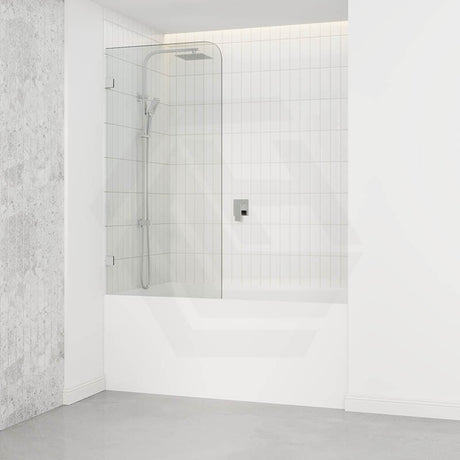
Wet rooms mean no screen, no hob, the whole floor drains freely and have picked up serious momentum lately. With no visual barriers anywhere, it reads as the roomiest of all the configurations. To satisfy the NCC, shower walls need waterproofing to 1800mm above the floor substrate, and your shower tiles must carry a slip-resistance rating that meets AS 4586. For a similar open effect without full-bathroom waterproofing, a frameless walk-in screen is worth considering — Covey has them from $130. A quadrant or square enclosure tucked into the corner defines the corner shower layout, and it works a treat in rooms around 2000mm × 1500mm where a free wall is available for the vanity. Once the layout's sorted, ventilation is the next practical thing to get right — and the earlier the better.
A windowless small bathroom must have an exhaust fan with a minimum capacity of 25 L/s (NCC 2022, ABCB Housing Provisions, Part 10.8) — that's the NCC's requirement for clearing air and steam.

Picking Small Bathroom Vanities
The vanity you choose has a significant effect on the overall feel of the finished room. Pick the wrong size and the design will feel all wrong.
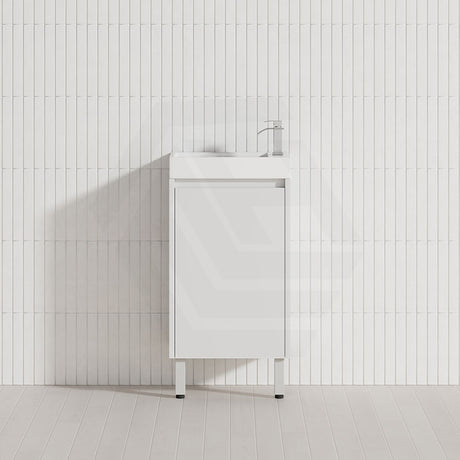
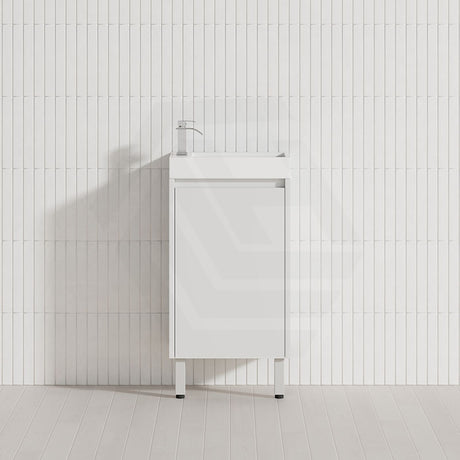
In a narrow room, start exploring small bathroom vanity options that measure 400mm to 600mm in width. A wall-hung vanity is worth considering — it creates the perception of more floor space and is easy to clean beneath. Lukka wall-hung vanities start at 400mm width, while CETO has 65 wall-hung vanity products across a number of configurations. A 600mm wide by 450mm deep vanity will work in most full bathrooms. If your bathroom is particularly tight, a vanity depth of 300–380mm may be worth considering. If structural wall considerations make a wall-hung vanity impossible, a floor-mounted vanity of the same width is a practical alternative. For wet areas, use PVC cabinetry rather than MDF. Entry-level 600mm PVC vanities start from around $300.
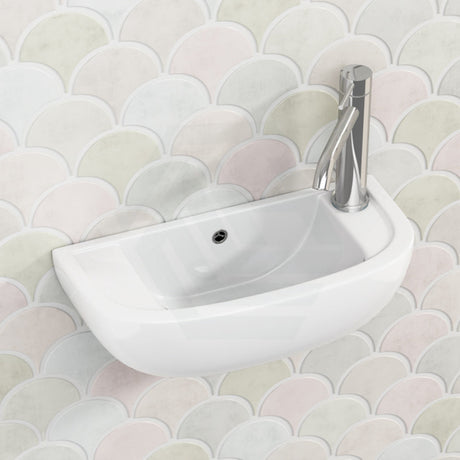
Remember to budget for a basin mixer and waste separately, as both are typically not supplied with a small bathroom vanity. When selecting your small vanity and basin, note how far the basin protrudes from the cabinet — it is easy to select a small vanity and basin and then find on installation day that the total depth exceeds the available space. One way to reduce overall cabinet depth in tight spaces is to pair a small bath vanity in the 400mm to 600mm range with a semi-recessed basin.

Small Ensuite Layout Tips: Maximising a Tight Footprint
Most small ensuite layouts sit somewhere between 1200mm × 1800mm at the compact end and roughly 2000mm × 1500mm. In rooms this size, one decision tends to ripple through all the others. Skip the bath if it's not essential — corner bathtubs run from $958 to $2,085 and chew up a lot more floor space than a shower.
A sliding or pocket door in place of a hinged one can genuinely transform a small ensuite layout. That 600mm to 820mm of swing clearance a hinged door eats up? A pocket door gives it straight back — and in an ensuite just 820mm wide, every millimetre counts.
A niche recessed into the wall beats a shower caddy for storage every time. A shaving cabinet with a built-in light ticks both boxes — storage and mirror in one compact unit — and prices start from $390 to $1,096. A built-in LED mirror needs a licensed electrician to hard-wire it — the installation must comply with the bathroom zone requirements set out in AS/NZS 3000:2018.
For most ensuite footprints, a vanity in the 400–500mm width range is the right call. Where overall depth is tight, a semi-recessed basin is the answer — the cabinet can be shallower without any sacrifice in basin size. Pair a small bath vanity with a semi-recessed basin and you've often got the smartest solution for a tight ensuite.
Waterproofing is a job for a licensed tradie — full stop. It has to be done to code, and it's not something to DIY. At least 1800mm above the floor substrate is the minimum for shower wall waterproofing, and every wall-to-floor transition needs to be fully sealed as well. Get the planning right and a small ensuite layout really doesn't have to be a headache.
References
National Construction Code 2022, ABCB Housing Provisions, Part 12.2 Livable Housing
National Construction Code 2022, ABCB Housing Provisions, Part 10.8 Condensation Management
AS/NZS 3000:2018 Electrical Installations (Wiring Rules), Standards Australia
National Construction Code 2022, ABCB Housing Provisions, Part 10.2 Wet Areas