

13 May, 2026
Bathroom Renovation Ideas: From Budget Makeovers to Luxury Upgrades
Explore bathroom renovation ideas for every budget. From quick tapware swaps to full luxury upgrades, this Australian guide covers it all.

Video Credit: Great Home Ideas
Budget Bathroom Makeovers: Maximum Impact, Minimum Spend
Picture entering your bathroom and seeing fresh white grout, matt black tapware, and a new light fitting that lights up the space perfectly. You don't always have to go all-in with your bathroom renovation ideas to get this look. Some of the best bathroom ideas are the most affordable.
If you stick with your tile layout for now, it will save you plenty of money. You can regrout and reseal them for $200–$400 for a standard bathroom. You can replace the basin mixers and shower sets for something more up to date. Meir and Bella Vista tapware ranges start at $56–$375 depending on finish. You can replace your existing light fittings too. The current trend is matt black or brushed gold and if your bathroom still has chrome tapware and fittings you can really change the look of the whole room when you swap to one of these options. Towel rails, hooks, and mirrors are things you can DIY so you can save on labour too.
Do not forget to check the waterproofing of your bathroom though. Waterproofing checks are essential to managing water ingress risk before any cosmetic work begins. You do not want to spend a few grand on your bathroom renovation ideas and then find that water ingress is occurring behind the tiles. A licensed tradesperson should inspect sealant points around the shower base and bath before you get started with the cosmetic updates. When you've exhausted the quick wins, you can start looking at things like new vanities and full retiles that add lasting value to your home. All of this should sit comfortably under $3,000 for a considered budget makeover.

Mid-Range Bathroom Renovation Ideas That Add Real Value
This is the bracket: roughly $5,000 to $15,000 is where bathrooms genuinely transform. The scope of work will include partial or full retiling, a replacement vanity, a new shower screen, and potentially a new rimless toilet suite. These are the bathroom reno ideas that add measurable value at resale and make everyday life feel noticeably better.
Porcelain outperforms ceramic in hardness and moisture resistance, making it the better choice for floors and wet walls. All floor tiles must meet AS 4586 slip-resistance P-ratings — a P4 or P5 rating is recommended for shower floors. Porcelain runs from around $30–$80 per piece at mid range, while ceramic sits closer to $6–$30. Beyond the tile choice itself, there are compliance requirements you cannot skip when retiling a wet area.
Any retiling that involves the shower or bath zone must comply with waterproofing requirements under the National Construction Code — shower walls must be waterproofed to a 1,800 mm waterproofing height (NCC 2022, ABCB Housing Provisions, Part 10.2) above the floor substrate, and wall-to-floor junctions require flashing with a 40 mm horizontal flashing leg at minimum. Waterproofing compliance standard is typically achieved via AS 3740:2021. Always engage a licensed waterproofer — this is not negotiable. Moving plumbing to reposition a vanity or toilet may also require a building permit depending on your state, so check with your local council early.
For those with a little more breathing room in the budget, stepping up to premium materials and bespoke fittings transforms a functional bathroom into a high-specification space worth significantly more at resale.

Luxury Bathroom Upgrades: Materials, Specs and Costs
Above $20,000, the bathroom becomes something else entirely. Freestanding baths from Broadway start around $878, with premium models reaching $7,182. Frameless walk-in shower screens in 10 mm tempered glass compliant with AS/NZS 2208, plus engineered stone or natural stone benchtops — these are the details that define a truly high-specification space.
Engineered stone benchtops are typically 20 mm thick and cost $500–$900 per linear metre installed. They offer consistent patterning and strong stain resistance. Natural marble brings unmatched visual warmth but requires sealing and more careful maintenance — costs vary considerably by slab grade and thickness, often starting at 20 mm and running to 30 mm for premium applications.
Underfloor heating is worth serious consideration here. Electric systems run at roughly 150–200 W/m² and suit most bathroom sizes, while hydronic systems offer greater energy efficiency for larger spaces but carry higher set-up costs. Both require a licensed electrician in compliance with AS/NZS 3000:2018 — underfloor heating electrical compliance, as well as LED mirrors and heated towel rails, all fall under this licensed electrician requirement (AS/NZS 3000:2018). If you want a reliable supplier that covers both system types and makes compliance straightforward, ThermoGroup offers quality options across both categories. WaterMark certification is mandatory for all water fixtures. Meir tapware is a strong choice at this tier. Whatever your budget, the constraints always come back to how well you use the space available.

Small Bathroom Renovation Ideas: Layout, Storage and Fittings
Most Australian bathrooms fall between 3 m² and 5 m², which is plenty to work with if you plan carefully. A small bathroom renovation works or fails on a good layout with clearances in mind. The relevant standard advises at least 600 mm clear space in front of a toilet suite and 550 mm beside a shower entry. Wall-hung toilets from $303 recover 150–200 mm of floor depth compared to floor-mounted models and make cleaning easier.
Shower niches cut into the wall eliminate the need for a separate shelf. A semi-recessed basin reduces projection without sacrificing cabinet depth. A mirrored shaving cabinet ($390–$1,096) delivers storage and reflection in one fitting — genuinely valuable in a smaller space. Larger format tiles such as 600×1200 mm can visually expand a small bathroom renovation but require a well-prepared subfloor and professional installation.
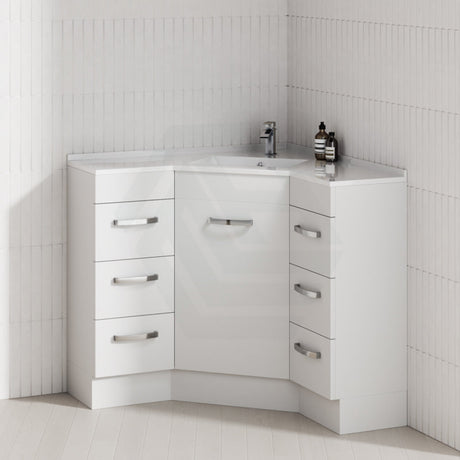
One of the best space-saving moves in any small bathroom renovation is a corner vanity, which turns an otherwise unused corner into functional storage.

Corner Vanity Ideas That Work in Any Bathroom
See a corner vanity bathroom in person and the logic clicks straight away — wall space opens up for a shower enclosure or towel rails, and the room just breathes better. Diagonally, a corner bath vanity tends to span 600–900 mm, with cabinet materials chosen to handle the demands of a high-humidity space.
For moisture resistance, PVC cabinets sit at the top of the list it's a solid pick for budget and mid-range renos alike. MDF cabinetry gives you a smoother painted surface and more colour choices, though it's not water-resistant by nature — the sealant and paint quality really do make the difference. Warmth and a premium feel come naturally with a solid timber corner vanity, though it needs proper water sealants and does best in a well-ventilated bathroom. Done right, a solid timber corner bath vanity reads as a design statement, not just another fitting.
Before you buy a corner vanity, check the rough-in plumbing — the waste outlet and water inlet points have to line up with the basin cut-out and the internal cabinetry plumbing. A licensed plumber has to handle this — basin and tapware connections are licensed trade work across Australia. Worth knowing: most vanities don't come with a basin mixer or waste, so budget for those separately. At the budget and mid-range end, Lukka, ABS, and MCH each have solid corner vanity options; Aulic and CETO are where you head for premium. In a well-planned bathroom, the right corner vanity just looks like it belongs — like it was never not there.
References
National Construction Code 2022, ABCB Housing Provisions, Part 10.2 Wet Areas
AS 3740:2021 Waterproofing of Domestic Wet Areas, Standards Australia
AS/NZS 3000:2018 Electrical Installations (Wiring Rules), Standards Australia