

15 May, 2026
Bathroom Vanity Height Guide: Finding the Right Fit
Choosing the right bathroom vanity height prevents back strain and costly mistakes. Our Australian guide helps you get it right first time.

Video Credit: KCBR Design | Remodel
Vanity Height: It Matters More Than Most People Realise
There's one renovation mistake that keeps people up at night: the vanity is at the wrong height. You don't realise it's off until the tiling is finished, the plumber has left, and you're left hunching over your new basin, staring at your toes as you try to brush your teeth. I have seen this happen, and let me tell you, vanity height mistakes are among the easiest to avoid.
The problems aren't just about discomfort when you're trying to clean up. A vanity that is too low can cause significant lower back strain as you're hunched over the basin, and a vanity that is too high can be just as uncomfortable because you will be lifting your arms awkwardly to do so. If you have a family or elderly members who use your bathroom, it is important that you get your vanity height just right, as it can be difficult for anyone shorter to use a vanity designed with a taller person in mind.
There is also another problem if you don't get your height right before you install the vanity. Many homeowners don't realise that your waste and water supply will need to be plumbed at the correct heights so that you don't run into any problems with the plumbing connections once the vanity has been installed. If you need to change the height after the fact, your licensed plumber will need to reposition those connections — adding cost and delay to what should be a straightforward installation.

Standard Vanity Height in Australia: What the Numbers Mean
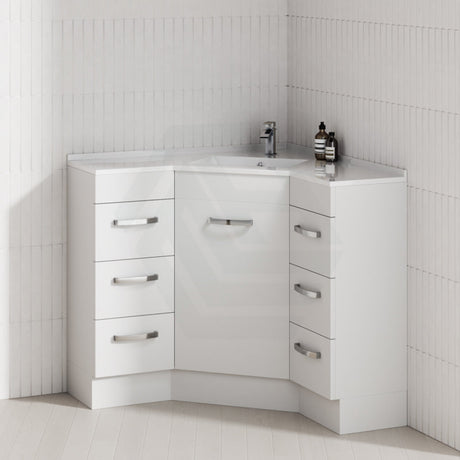
Here's something that catches a lot of people off guard — no mandatory Australian Standard actually dictates bathroom vanity height for residential builds. What exists instead is an industry convention — measured from finished floor to the top of the benchtop — that puts the standard at 860mm (NCC 2022, ABCB Housing Provisions, Part 12.2).
That said, it's worth being clear on exactly what that height covers. That 860mm figure is a combined total — it's the cabinet body (typically around 820mm on most wall-hung units) with the benchtop and basin thickness added on top. Stone benchtops with a ceramic inset basin stack up taller than a flush-fit ceramic top — the individual components really do make a difference. When you're picking a vanity, ask your supplier for the full installed height — the cabinet body measurement alone won't tell the whole story.
Bathrooms renovated before 2000 were often fitted at around 800mm — that was the comfort-height convention of the time. Once you've used a vanity at 860mm, the older height feels noticeably low — and most people have no interest in going back.

Picking the Right Vanity Height for Your Household
The standard range gives you a starting point, sure — but the right vanity height really comes down to who's using the bathroom day to day.
For households where the main users are over 180cm tall, some designers recommend pushing the installation height up to 900mm. Users under 160cm generally find anything closer to 820–840mm a much more natural reach. For adults in the 160–180cm range, 860mm sits comfortably — which is precisely why it became the default.
A main bathroom shared by the whole household, though, is a trickier situation. Small children, older parents, or a family member with mobility needs — any of these change the picture considerably. Wheelchair-accessible vanities fall under AS 1428.1, which recommends 720–820mm, and the NCC's Livable Housing provisions — in force for new Class 1a dwellings from October 2023 — introduce broader accessibility requirements that are worth raising with your builder before a full renovation. In a typical family main bathroom, my general advice is to go with 860mm and grab a step stool for the kids — that's a far simpler fix than dropping the vanity height for the whole household.

Width and Depth: The Other Vanity Dimensions That Matter
Height sorted, the next question is width and depth — these two bathroom vanity dimensions decide whether the vanity actually fits the room and handles your storage needs.
In the Australian market, width options start at around 400mm for compact powder room units and step up through 600mm, 750mm, 900mm, 1200mm, and 1500mm, right through to full double-vanity formats. A 750mm bathroom vanity hits a sweet spot for versatility — it's big enough for a main bathroom in an average family home and usually comes with solid storage across a single or two-drawer layout. At the larger end, an 1800 vanity is your standard double-vanity unit — a natural fit for a master ensuite used by two people daily.
Across most of the Australian market, standard vanity depth sits at 450mm — enough to reach the basin comfortably without eating too far into the bathroom floor space. Clear floor space in front of a vanity must be at least 600mm under most building codes — confirm this with your certifier before locking in the position.

Common Vanity Installation Mistakes — and How to Avoid Them
The most frequent vanity installation blunder is ordering the vanity without establishing the rough-in plumbing height first. The position of your basin waste outlet and water supply lines need to sit within the vanity cabinet's configuration — if they don't, you're looking at extra cost to engage a licensed plumber to move them.
Tile height is another factor. If you tile the floor after the plumbing rough-in is complete, the finished tile thickness will raise the finished floor level by 10–15mm. That means your installed vanity height will drop by the same amount if you forget to account for it — leaving you at 845mm rather than your intended 860mm.
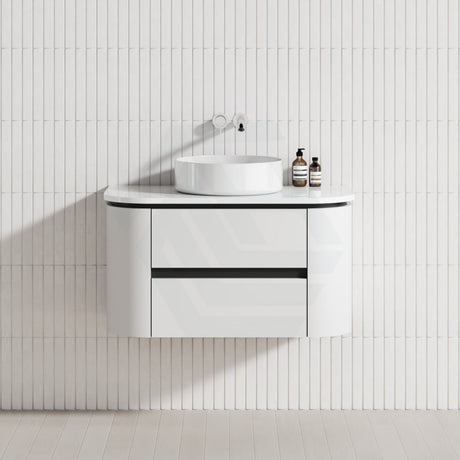
Wall-hung vanities are among the most popular bathroom vanity types right now, and for good reason. They need to be fixed to wall studs or pre-installed noggins. The cabinet installation can be a competent DIYer project, but all basin waste and water supply connections must be completed by a licensed plumber — this is a legal requirement across all Australian states, and the licensed plumber must provide certification on completion. For larger formats such as 1800mm vanities in a double ensuite, verify that the wall structure can support the cabinet weight before ordering — essential preparation that can save considerable trouble later.
References
National Construction Code 2022, ABCB Housing Provisions, Part 12.2 Livable Housing
State plumbing licensing legislation (VBA Victoria; Fair Trading NSW; QBCC Queensland; Building Practitioners Board WA; CBOS Tasmania; ACTPLA ACT; Building & Energy SA; ABPB NT)
AS/NZS 3500.2 Plumbing and Drainage — Sanitary Plumbing and Drainage, Standards Australia