18 May, 2026
Bathroom Vanity Dimensions: A Complete Size Guide
Get bathroom vanity dimensions right before you buy. Our Australian guide covers height, width and depth so your vanity fits perfectly.

Video Credit: Mom Can Fix It
Why Vanity Dimensions Matter Before You Buy
The most prevalent error I see in the bathroom space is getting your vanity dimensions wrong. The downside of this is usually monetary. As I have seen first hand, you get your vanity and it doesn't fit (doesn't open, is too tall for the window reveal, etc) and you have to pay to return the product, get a plumber to fix it and potentially have to replace some of the tiling.
The thing is, bathroom vanity dimensions aren't just one number. You have height, width and depth to consider. They all have to fit into the space, along with how the rest of your bathroom fittings will fit in with the vanity. This is everything from bath, shower, toilet, door, etc. So, make sure you measure them up correctly before you buy and you won't end up with a morning wondering why your vanity isn't suitable for the space.

Standard Vanity Height: What Australian Bathrooms Use
The industry-standard vanity height is currently sitting between 850 mm and 900 mm from your finished floor level to the basin rim. Before it was more around 750 mm–800 mm, which is what was used in Australia for many years. You can definitely see the difference in more recently built bathrooms. The higher standard vanity height is definitely more comfortable, especially if you are taller than average.
Wall-hung vanities give you the ability to change the bathroom vanity height if needed to suit your household. If you have a family of tall adults, you may want to go higher, such as 900 mm. But if accessibility is a priority, 820 mm is the height to aim for, which aligns with AS 1428.1 accessible design guidance.
Floor-mounting the vanity, though, means you have the vanity height pre-determined by the cabinet height. So, it's important to check this on the specification sheet before you order, and make sure it will work in your space.
Something to note as well: ensure that you are measuring from your finished floor level. This means when your tiles are down. A standard 10 mm tile on a 5 mm bed raises your floor height by 15 mm, which could impact you if you're trying to achieve a certain bench height.

Vanity Width and Depth: Sizing for Your Floor Plan
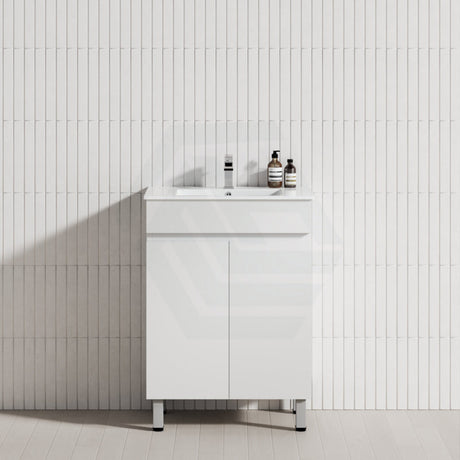
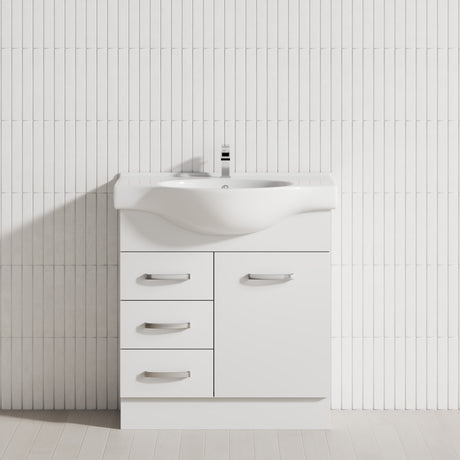
Vanity widths in Australia range anywhere from 400 mm for a compact powder room unit, all the way up to 1800 mm for a large double-basin configuration. The 900 mm single-basin vanity is by far the most popular as it can easily fit in the vast majority of Australian bathrooms and ensuites without making your space feel too crowded.
Standard cabinet depth runs at 450 mm to 500 mm across most wall-hung and freestanding models. For the long and slender ensuite — typically seen in apartment renovation work — you might want to check out the slimline options which range between 350 mm to 400 mm. While you do give up some under-bench storage, you may also gain a door which does not clash with the vanity.
For powder rooms, a single unit between 400 mm and 600 mm wide is usually the right call. Main bathrooms tend to suit 750 mm to 900 mm. Double vanities at 1200 mm and above are becoming more and more popular in master ensuites and, for a two-person household, they are a truly life-changing addition.

Choosing the Right Dimensions for Your Bathroom Layout
Knowing the standard bathroom vanity dimensions is not the whole story. You also need to understand how your vanity size works with everything else in your bathroom.
For comfortable daily use, there should be a minimum clear floor space in front of the vanity of 600 mm. Accessible design per AS 1428.1 recommends at least 800 mm of clear floor space, which is definitely a worthwhile design choice if you are building a new bathroom or undertaking a significant renovation.
One of the most common mistakes when choosing a bathroom vanity is making it too big for a small bathroom. In a 2.4 m × 1.8 m bathroom, for example, a 1200 mm wide vanity that looks proportionate in a showroom can leave you shuffling sideways past the door just to reach the shower.
It is also useful to carefully consider where you are locating the vanity alongside other fixtures. If your new bathroom features a soaking tub, for instance, you can no longer locate a vanity along that wall. The dimensions and position of luxury bathtubs and soaking bath tubs should all be confirmed relative to the vanity before any tiling commences, to ensure the vanity fits without creating an awkwardly narrow passage. Drawing up a scaled floor plan and confirming your vanity width before building works commence saves hours of time and frustration.

Vanity Installation: Measurements, Clearances and Fit-Out Tips
Once you have confirmed your bathroom vanity dimensions, you can move forward with the vanity installation process.
First, check the position of your rough-in water pipes to confirm the waste outlet and water connections line up with your new vanity's depth and internal configuration. If you have selected a wall-hung vanity, consider where the vanity is being mounted and where any wall studs are. Wall-hung vanities require a solid timber wall stud for mounting — you cannot mount a vanity to a plasterboard wall alone. Australian wall framing typically comes in 450 mm or 600 mm centres (NCC 2022, ABCB Housing Provisions, Part 12.2), so locate your stud positions prior to purchasing your vanity to verify they align correctly for your vanity installation.
Once your vanity is mounted, the basin must be connected to your water supply and waste pipes by a licensed plumber (state plumbing licensing legislation). Only a licensed plumber can carry out this work, and on completion you will be issued with a compliance certificate confirming the installation meets your state or territory's plumbing code. Where the rough-in is correctly positioned, a licensed plumber will typically complete the connection work in two to four hours.
Assembling a flat-pack vanity cabinet and mounting the cabinet to the wall are DIY-legal tasks — this work is not regulated plumbing work.
A couple of typical mistakes when mounting a wall-hung vanity: not accounting for finished floor height when setting bracket positions, and forgetting to check that doors will not clash with the vanity once fitted. Before finalising your bracket positions, confirm your wall framing depth (typically 70 mm–90 mm stud depth) suits the bracket system specified for your chosen unit (AS/NZS 3500.2). Also include an expansion silicone joint where the vanity meets adjacent tiled walls, to allow for movement.
References
National Construction Code 2022, ABCB Housing Provisions, Part 12.2 Livable Housing
State plumbing licensing legislation (VBA Victoria; Fair Trading NSW; QBCC Queensland; Building Practitioners Board WA; CBOS Tasmania; ACTPLA ACT; Building & Energy SA; ABPB NT)
National Construction Code 2022, ABCB Housing Provisions, Part 10.2 Wet Areas
AS/NZS 3500.2 Plumbing and Drainage — Sanitary Plumbing and Drainage, Standards Australia