

29 May, 2026
Coastal Bathroom Ideas Australia for Australian Bathrooms
Discover coastal bathroom ideas Australia homeowners love. From Queensland to the Surf Coast, bring the beach inside your bathroom.

Video Credit: Hunting for George
What Makes a Coastal Bathroom Style Work in Australia
Picture your bathroom — no longer just an enclosed room, but an escape where salt and sea air are brought inside. There is that sense of the outdoors, but only if a well-designed coastal bathroom style has been executed. And it is safe to say there is no place to experience this feeling quite like Australia. In Australia, the beachy look is not a borrowed style but a local one, with many homes located near waterways. This goes all the way from Queensland-style homes in Brisbane, old Federation terraces in Sydney's Eastern Suburbs, and to the new-build beachside homes in Victoria's Surf Coast.
But what is it about this particular style that works? Coastal style works well with the use of natural textures, a restrained colour palette of whites, soft blues, sandy neutrals and warm timbers, and an airy and spacious feel, in keeping with the natural elements outside.
It is worth saying that coastal style shares some similarities with the Hamptons style, but it isn't the same thing. The Hamptons style has formal qualities including panelled joinery, navy accents and other decorative elements. The coastal style has a more free feeling, a casual style that matches the laid-back Australian beach lifestyle. The functional requirements also play a big role. High humidity levels, corrosive salt air in coastal areas, and lots of bright natural light all impact how long your finishes last and how quickly they degrade. That makes for coastal bathroom ideas Australia-wide that are shaped as much by the unique environment as by aesthetics.

Materials and Finishes That Suit the Australian Coast
With coastal bathroom styles in mind in an Australian context, let's move on to materials and finishes that can cope with being located right near the beach.
Porcelain tiles are the clear frontrunner for coastal bathrooms. They absorb less than 0.5% water — significantly lower than ceramic — making them ideal for high-humidity environments. Stone-look and travertine-look porcelain tiles are especially popular right now, bringing organic coastal warmth without the sealing requirements of natural stone. Expect to pay roughly $35–$120 per m² for quality stone-look porcelain supply. For floor tiles, always check the slip-resistance P-rating per AS 4586 — a P4 or P5 rating is recommended for wet bathroom floors, and matte finishes generally comply more readily than gloss.
For hardware, salt air is genuinely corrosive over time. Brushed nickel and matte black finishes in 304 stainless steel construction resist corrosion far better than standard chrome in coastal environments. Meir's brushed nickel range is a strong option here — the warm metallic tone reads beautifully against white subway tiles or sandy stone-look porcelain.
Waterproofing is non-negotiable and legally required. Under NCC 2022, shower walls must be waterproofed to at least 1,800 mm (NCC 2022, ABCB Housing Provisions, Part 10.2) above the floor substrate, and bath-adjacent walls to at least 150 mm above the rim. Compliance can be achieved via AS 3740:2021, which outlines membrane application requirements for domestic wet areas. This work must be completed by a licensed tradesperson before any tiling begins.

Layout and Sizing Considerations for Coastal Bathrooms
Choosing suitable materials is only one part of the overall equation — how your chosen materials fit into the floor space available to you is equally important in determining both the coastal bathroom ideas Australia homeowners rely on and the bathroom's liveability.
A full bathroom in a typical Australian home runs around 3–4 m², while an ensuite is often 2–3 m². Within those dimensions, clearances matter. A minimum of 600 mm in front of the toilet pan and 300 mm either side of the basin centre line keeps the space functional and comfortable.
Ventilation is critical — arguably more so in a coastal home where humidity is already elevated. A windowless bathroom requires an exhaust fan rated at a minimum of 25 L/s (NCC 2022, ABCB Housing Provisions, Part 10.8). Even bathrooms with windows benefit from mechanical exhaust as well. Ventilation is the silent guardian of your coastal bathroom: get it wrong and you could have mould in those gorgeous travertine-look tiles within a season.

Fixtures and Fittings: Vanities, Toilets, and Baths
Once you have mapped your layout and your ventilation plan is ready, you can select the fixtures to really set the style and purpose of your coastal bathroom design.
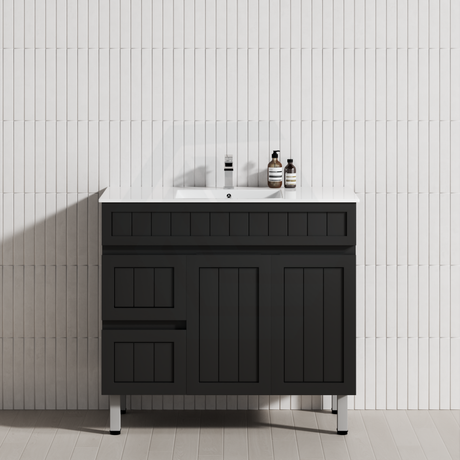
Hampton bathroom vanities work very well for a coastal bathroom design, typically featuring panelled doors and finishes in soft white or woodgrain to give the room a comfortable, coastal ambience. Wall-hung vanities ranging from 600–1,200 mm wide work well in smaller ensuites, while freestanding vanities on legs — generally 750–1,500 mm wide, costing from $238–$1,378 — look lovely in more spacious bathrooms. For coastal bathrooms, PVC cabinet construction is recommended over MDF, as PVC is naturally impervious to moisture. Note that all tapware must be installed by a licensed plumber.
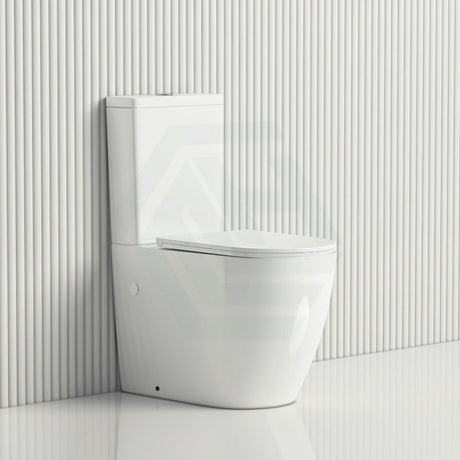
All fixtures installed in Australian bathrooms must be WaterMark certified, as this is a compulsory national product certification for plumbing and drainage products. A back to wall toilet suite is a great selection for a coastal bathroom — the concealed cistern offers a streamlined appearance that suits light coastal décor, and a rimless pan is much easier to keep clean. Quality examples run between $185–$1,199.
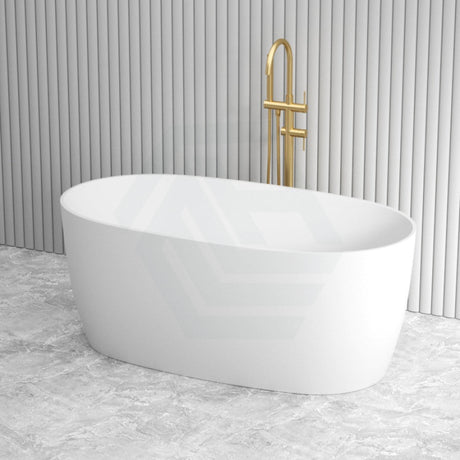
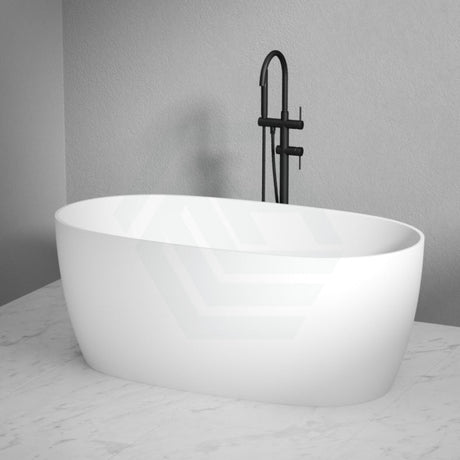
If you want to create a focal point, a freestanding bath is a strong choice. Acrylic freestanding baths generally range from 1,500–1,700 mm in length, are much lighter than cast iron, and start at approximately $878. These baths require a minimum clear floor area of 1,800 mm, so they suit more spacious bathrooms best.

Pulling It All Together: Practical Coastal Bathroom Tips
Once you have chosen your key fixtures, it helps to consider the full renovation process — costs, trade sequencing, and common mistakes.
For a typical bathroom reno, costs usually fall between $8,000 and $20,000 or more, depending on fixture selections and the extent of tiling involved. Order matters. Allow time for plumbing rough-in, waterproofing (which must pass inspection before tiling), tiling, and then fixture installation. Skipping or rushing the waterproofing step is the most expensive mistake made during a bathroom renovation.
A clawfoot bath can also serve as a stunning centrepiece for your coastal bathroom ideas australia renovation plan — an heirloom piece that pairs beautifully with brushed nickel floor mixers and subway or zellige-style wall tiles.
Don't over-tile with busy designs; coastal interiors thrive on minimalism. A single large-format stone-look porcelain tile for the floor, a timeless subway or zellige-style tile for the walls, and metallic fixtures in a warm tone are all that's needed. Choose accessories — towel rails, hooks, and mirrors — in 304-grade stainless steel to withstand the coastal atmosphere. These are DIY-friendly installations. If you're incorporating an LED mirror or heated towel rail, all electrical work in wet areas must be performed by a licensed electrician with RCD protection under AS/NZS 3000. With the right materials, trades, and plan in place, your coastal bathroom will be a retreat you enjoy every day.
References
National Construction Code 2022, ABCB Housing Provisions, Part 10.2 Wet Areas
AS 3740:2021 Waterproofing of Domestic Wet Areas, Standards Australia
National Construction Code 2022, ABCB Housing Provisions, Part 10.8 Condensation Management
WaterMark Certification Scheme, Australian Building Codes Board
AS/NZS 3000:2018 Electrical Installations (Wiring Rules), Standards Australia