

15 May, 2026
Green Bathroom Ideas: Fresh Colour Palettes and Natural Accents
Explore green bathroom ideas for your next reno. From soft sage to deep emerald, find the right shade for any Australian bathroom.

Video Credit: Chillaxie
Choosing a Green Shade That Actually Works in Your Bathroom
Right now, green is everywhere in bathroom renos — and for good reason. Remember those avocado bathroom suites from decades past? Long gone — today's green reads as genuinely sophisticated. For years, all-white bathrooms ruled the reno world — then green crept in and quietly claimed the top spot.
What surprises most people is just how many shades of green suit a bathroom. Sage and mint are basically neutrals — their white and grey content means they push light around the room pretty effectively. These lighter shades do their best work in compact or windowless bathrooms. For something darker, hunter green, forest green, and deep emerald are the ones to consider. These shades hit hard — they need a larger room, decent ceiling height, and solid natural light to carry them.
Olive green is another shade that keeps popping up. A yellow-green base puts it somewhere in the middle, lending it a warmer, more organic character. Timber is its natural companion.
Once the right shade is locked in, the next decision is finish.

Bathroom Paint Ideas: Finishes, Durability, and Application Tips
Where so many bathroom renovations fall short is choosing the appropriate finish alongside the colour. Bathrooms are exposed to significant amounts of moisture, so the bathroom paint ideas you pursue need to account for that.
A low-sheen paint could be a good choice for dry walls outside the wet zone, as it hides uneven surfaces and has a gentle, contemporary finish. Semi-gloss is better suited for walls alongside showers and basins: more moisture resistant, easy to wipe clean, and longer lasting. Full gloss provides the highest moisture resistance but highlights every flaw in your walls, so surface preparation needs to be thorough. Expect to pay roughly $60 to $90 per litre for a quality bathroom-specific paint.
Make sure you prime any uncoated plaster prior to painting. Skipping this step is a false economy that leads to peeling within a year or two. A mould-resistant primer is a wise investment in wet-zone applications. Also be mindful that under the National Construction Code, shower walls must be waterproofed to at least 1,800mm (NCC 2022, ABCB Housing Provisions, Part 10.2) above the floor substrate, and bath-adjacent walls to 150mm above the bath rim. Paint is not a substitute for compliant waterproofing. Ventilation matters equally — windowless bathrooms must achieve a minimum exhaust rate of 25 litres per second (NCC 2022, ABCB Housing Provisions, Part 10.8) under current requirements.
With those compliance boxes ticked, allow freshly painted surfaces to cure for 48 to 72 hours before exposing them to steam and humidity. After that, you can consider how your chosen green works alongside the other colours and materials in the room.

Bathroom Colour Ideas: Pairing Green With Neutrals and Naturals
Most people think matching green is tricky — it's really not. The undertone is your starting point. Warm greens — those with a yellow or olive base — pair naturally with timber, brass, and off-white. Sage and eucalyptus carry a blue-grey base — crisp white, chrome, and terrazzo are their natural companions.
Three combos I'd reach for without hesitation: sage green walls paired with white subway tiles and a warm timber vanity; forest green on a feature wall behind a freestanding bath, grounded by large-format white floor tiles; olive green set against charcoal terrazzo and brushed brass tapware. Every one of them works for the same reason — the green has something to push against, a contrast or a complement rather than a fight.
Grout colour seems like a small call until you see what it actually does: white grout with green tiles is crisp and modern; charcoal grout brings definition and a bit of weight; sand-toned grout softens everything and sits well with cool-toned greens.
Wall and tile colours sorted — now the vanity needs attention.

Bathroom Vanity Ideas: Materials, Cabinetry Colours, and Sizes
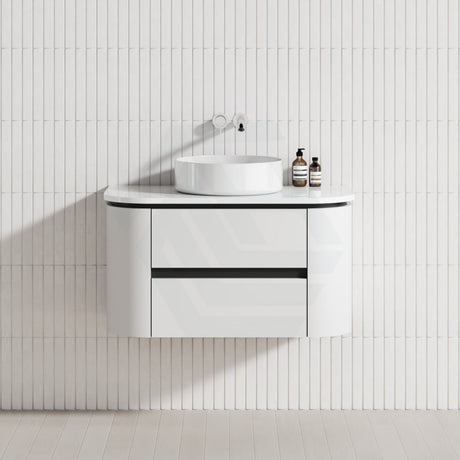
The bathroom vanity is where a green bathroom ideas design is made or broken. White cabinetry is the default — it sits against green in a crisp, clean, and fresh manner. A bathroom vanity dark finish, such as charcoal or near-black, paired with sage or forest green walls creates a powerful contrast and a striking visual. A timber-look cabinetry finish is another strong contender, particularly from Aulic and Lukka, both of which offer woodgrain-finish cabinets in real plywood, giving the bathroom an organic, natural look alongside green walls.
On materials: PVC cabinetry is waterproof and an attractive solution for those on a budget, while MDF is less moisture-resistant and should only be used in lower-humidity spaces with adequate sealing. A premium plywood vanity — such as those from Aulic, featuring natural woodgrain finishes and Häfele hardware — will last a lifetime and deliver the most visually pleasing result for a long-term fit-out.
Standard Australian vanity widths are 600mm, 750mm, 900mm, and 1,200mm. Aim for at least 600mm of clearance on at least one side for comfortable use. If you are undecided on configuration, bathroom vanities with sinks is a good place to begin, as an integrated basin simplifies the overall design process.

Completing the Look: Fixtures, Hardware, and Natural Accents
Tapware finish has more influence over the room's feel than most people give it credit for. For warmer greens — olive, sage, forest — brushed gold is a hard one to beat. Basin mixers in brushed gold from Meir and Fienza sit across a mid-to-premium spread — $150 to $456. Brushed nickel suits blue-greens well — it's understated where brushed gold would be too loud. Matte black reads sharp against lighter shades like sage and mint, but next to deep forest green it can tip into overwhelming — and regardless of what finish you settle on, a few rules don't bend. All tapware must carry WaterMark certification, the install needs a licensed plumber, and hot water at every bathroom outlet is capped at 50°C (AS/NZS 3500.4) — none of that is optional.
Pick the right natural accents and a green bathroom goes from decent to something genuinely impressive. Sealed timber shelves add warmth, a stone or concrete vessel basin brings sculptural form, and rattan accessories throw in texture — keep all of it well away from direct water contact. A ThermoGroup heated towel rail in brushed gold or brushed nickel earns its place on both counts — practical and good-looking — though the hardwired install means a licensed electrician is non-negotiable. Across towel rails, robe hooks, and toilet roll holders — the hardware finish should be the same throughout. It's the detail that separates a designed bathroom from one that was simply put together. If you've gone with a bath vanity with sink, the ranges above have plenty of integrated options to match.
References
National Construction Code 2022, ABCB Housing Provisions, Part 10.2 Wet Areas
National Construction Code 2022, ABCB Housing Provisions, Part 10.8 Condensation Management
WaterMark Certification Scheme, Australian Building Codes Board
AS/NZS 3500.4 Plumbing and Drainage — Heated Water Services, Standards Australia