10 November, 2026
What Is a Floor Waste? Types, Grates and How to Choose One
What is a floor waste? It's the fitting that drains a shower floor, with grate styles including tile insert, standard and strip. Read our guide.

Ever stood under the shower and wondered exactly where all that water ends up? Honestly, it wasn't something I'd thought about until bathroom specification became part of my job. A floor waste, put simply, is the fitting set into the shower floor; a grate sits on top, an outlet sits beneath it, and together they catch water and pass it down to the pipe below. You'll find outlets in common sizes such as 50, 75, 80, 88, 90 or 100mm, and from there the choices open up: a tile insert for a seamless finish (my favourite, hands down), a standard grate, or point waste versus strip grate layouts, with the right pick coming down to your shower design and budget.
Video Credit: Factory Solution
What's the Job of a Floor Waste?
In a shower or wet area, the floor waste is the fitting set into the floor, catching water and draining it away to the pipe underneath. Two pieces make it up: the grate, visible and sitting atop the tiles, and the outlet, which sits beneath and connects through to the pipe. Anyone asking what is a floor waste usually wants to know whether one's needed outside the shower too; the NCC Housing Provisions call for a floor waste within the shower area itself, but not elsewhere in a house bathroom or in a laundry.
Sitting directly over the outlet, the grate gives water an immediate path to drain the moment it hits the floor. Outlets come in common sizes such as 50, 75, 80, 88, 90 or 100mm, and the size you require depends on the size of the pipe you already have in the floor (your plumber will advise you of this prior to ordering).
This is the stage of a renovation I find most homeowners ignore without a second thought, until they find themselves in the shower thinking "why was nobody telling me there were options?"

Where It's Required and Who Fits It
A floor waste is required in any shower area under the National Construction Code. The Housing Provisions do not require a floor waste in the rest of a standard home bathroom or in a laundry (South Australia has its own variation). Apartments do need one in a bathroom or laundry situated above another unit or public space.
No matter where it sits, a floor waste needs the surrounding floor to slope towards it at a gradient of between 1:80 and 1:50 (NCC 2025, ABCB Housing Provisions, Part 10.2); there are slight state variations, so it's worth checking the rules for your specific location.
Because fitting a floor waste counts as drainage work, a licensed plumber has to install it, no matter which state or territory you're in. The waste also forms part of the waterproofing system, which means a qualified waterproofer has to fit the membrane around it (licensing rules vary from state to state) — though fitting and connecting the waste remains a licensed plumber's job. DIY simply isn't an option here, given it's drainage and waterproofing work that has to be right from the first attempt.

Tile Insert or Standard Grate?
Once the legislation and trades are taken care of, the homeowner has a decision to make regarding how the grate looks once it is installed.
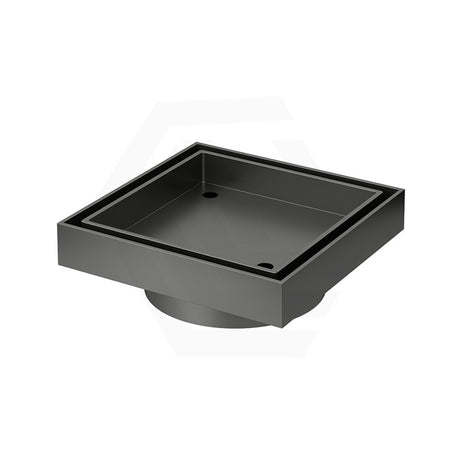
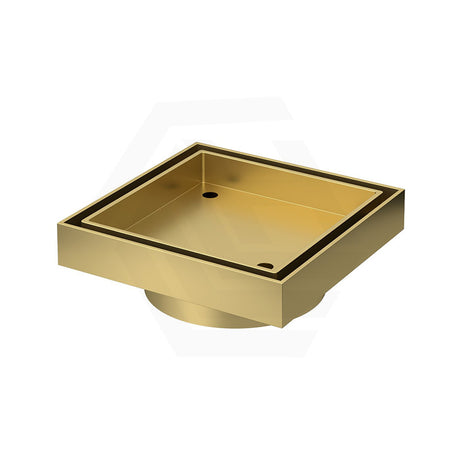
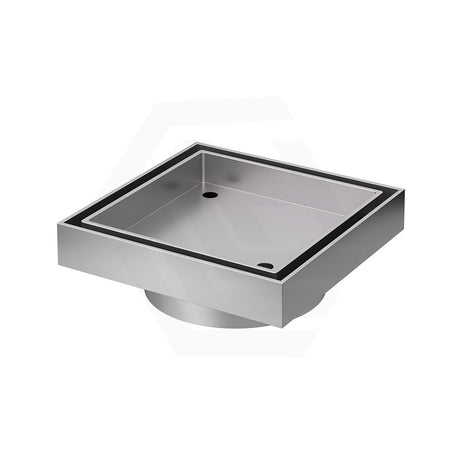
One option is how much of the waste you want to see. A tile insert floor waste has a tray into which your floor tile fits, so that the waste can blend into the floor of the shower. The majority of these products state the max tile thickness they can accept; if they don't, ask first, or look at the product spec sheet. Then leave the outlet size to your plumber, because it needs to align with the pipe. Some of the 2-in-1s allow you to use either a tile insert or a regular cover, while others just have the standard grate showing. I have to say a tile insert is probably my favourite for creating a seamless, or near-seamless, floor. It works particularly well with large-format tiles. In either case, slip resistance is still important. For residential bathrooms, a wet pendulum rating of P3 (AS 4586:2013) is commonly recommended, even though it's not actually part of the NCC.

Strip Grates in Showers
A point waste isn't the only type of grate, and the other common type collects water across a length rather than at a single point. Our range of tile insert grates includes both square and round point wastes as well as long strip and channel grates, found at our tile insert grates collection. Where it goes and how the floor falls to it should be discussed with your plumber, tiler and waterproofer. Slimline profiles can be suited to renovations where there is a limit to the height available for the installation, but make sure to ask your waterproofer and plumber if a slimline profile suits your floor build-up. Cut-to-length strip grate orders, such as those from Lauxes and Joemo, are generally non-returnable once cut, so make sure you get the shower measured before you buy (not after the tiler has started).

Handling Long Runs and Corners
A single straight line isn't the only option for strip grates. Using grate joiners, a run can turn around a corner, or two separate runs can be connected into one longer length. My advice is to match the joiner's profile and finish to the grate's so the join stays discreet. Before any tiling starts, sort the layout out with your tiler and plumber. Since joiners are sold separately, order them in the same finish as the grate so everything matches. Get the grate sorted early and it becomes a feature nobody notices — which, for a shower floor, is exactly the point.
References
National Construction Code 2025, ABCB Housing Provisions, Part 10.2 Wet area waterproofing
National Construction Code 2025, ABCB Housing Provisions, Part 3.3 Drainage, Australian Building Codes Board
AS/NZS 3500.2:2025 Plumbing and Drainage — Sanitary Plumbing and Drainage, Standards Australia
AS 4586:2013 Slip resistance classification of new pedestrian surface materials (incorporating Amendment No. 1:2017), Standards Australia
Plumbing licensing requirements, state and territory plumbing regulators